

What if the greatest threat to your next deal isn’t a shift in market sentiment, but a hidden circular reference buried in an associate’s spreadsheet? In high-stakes finance, a single modeling error can derail a multi-million dollar valuation or an entire investment thesis. Building a compelling business case for financial modeling training is no longer just about professional development; it’s about institutional survival and deal velocity. You’ve likely seen how inefficient workflows and technical gaps lead to slow turnarounds and avoidable audit risks that no firm can afford.
We know that elite performance requires more than just basic Excel skills; it demands a mastery of complex structures like LBOs and M&A modeling. This article explores how specialized training transforms from a simple line-item expense into a high-yield investment for your team. You’ll discover how to standardize workflows, integrate the latest 2026 IFRS 9 amendments for ESG-linked cash flows, and drastically reduce audit risk. We’ll show you how institutional-grade training through FMU builds the technical confidence needed to accelerate your career velocity and firm-wide ROI.
Financial modeling is the silent engine of every major capital allocation decision. It’s where strategic intent meets mathematical reality. When this engine fails, the consequences are rarely minor; they are catastrophic. History is littered with “Excel blunders” that have cost firms billions, from the London Whale incident to the Reinhart-Rogoff coding error. These weren’t just simple typos. They were fundamental failures in structural logic that went undetected until it was too late. In the high-stakes environment of 2026, “template-tweaking” is no longer a viable strategy for firms that value their reputation and their capital.
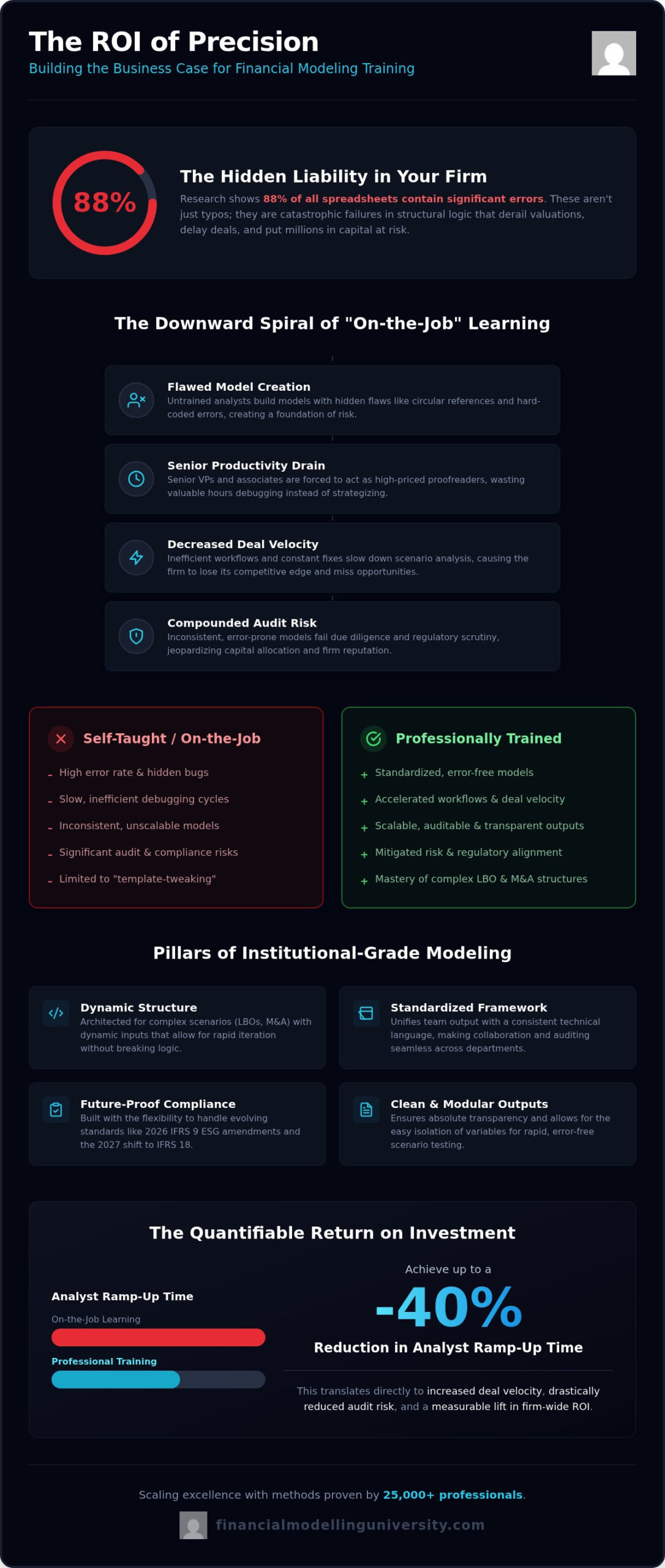
Many firms fall into the trap of relying on “on-the-job” learning. This is a false economy. The hidden costs are staggering. Senior associates and VPs spend hours acting as high-priced proofreaders, fixing broken circular references and hard-coded errors that should never have existed. This drains senior productivity and delays deal execution. Building a strong business case for financial modeling training requires recognizing that professional instruction isn’t just an expense; it’s a risk-mitigation strategy that protects the firm’s most valuable assets.
Model risk is now a formal institutional hazard. A single error in a five-year LBO forecast doesn’t just skew the current year; it compounds across the entire debt schedule. With the January 1, 2026, amendments to IFRS 9 and IFRS 7 now in effect, firms face increased regulatory pressure to provide transparent, error-free models, especially regarding ESG-linked cash flows. Furthermore, the upcoming shift to IFRS 18 in 2027 means that models built today must be flexible enough to handle new classification standards for operating and investing categories. Without professional training, your team is likely building models that are already obsolete or, worse, inherently flawed.
The true business case for financial modeling training is found in deal velocity. Contrast the speed of a pro-trained analyst with a self-taught junior using inefficient hacks. When an entire team operates within a standardized Excel for finance framework, debugging time drops toward zero. Models become modular and predictable. This allows the team to iterate faster, testing twenty deal scenarios in the time it used to take to fix a single broken link. In private equity and investment banking, the ability to pivot faster than the competition is often the difference between winning a mandate and losing it. Elite firms don’t wait for errors to happen; they train their staff to build models that are right the first time.
An institutional-grade model is an architected tool, not just a list of calculations. Too often, firms rely on spreadsheets that lack structural integrity, leading to a dangerous lack of transparency. Research indicates that 88% of all spreadsheets have significant errors. This isn’t just a statistic; it’s a liability that can compromise an entire investment thesis. Elite firms eliminate this risk by moving beyond basic Excel toward models built with dynamic inputs and clean, modular outputs. This ensures that changing a single variable updates the entire forecast without breaking the underlying logic.
Standardization is the backbone of team efficiency. When every analyst uses a different layout or formula style, senior review becomes a bottleneck. A unified technical language ensures that a model built by a junior in London can be audited by a VP in New York in minutes. This consistency is a primary driver in the business case for financial modeling training. It turns individual skill into a scalable firm asset. To maintain this edge, teams should look toward the FMU All-Access Pass to standardize their technical output across all departments.
Real investment banking financial modeling isn’t about data entry. It’s about building flexible valuation engines. Pro-grade DCF models include robust sensitivity tables and scenario toggles that allow leadership to visualize “what-if” outcomes instantly. These tools provide the clarity needed for high-stakes decisions. They integrate real-world market data rather than relying on static, outdated assumptions. Mastery here means your models become strategic assets that drive deal conviction.
Generic Excel training fails because it ignores industry-specific mechanics. For instance, real estate financial modeling (REFM) requires mastery of waterfall distributions and development pro-formas that general courses don’t cover. Similarly, private equity financial modeling demands precision in LBO debt sizing and tax-efficient structures. Nuance is the difference between a theoretical exercise and a deal-ready model. Mastering these pillars strengthens the business case for financial modeling training by ensuring every work product meets the highest industry standards.
Finance leaders often treat professional development as a discretionary line-item expense. This perspective ignores the significant, albeit indirect, costs of the self-taught model. When an analyst learns on the job, the firm pays for their education through lost productivity and senior associate time. Professional training shifts this burden. By investing in a structured business case for financial modeling training, firms can objectively measure the transition from a cost center to a profit engine.
The most immediate metric for any CFO is “Analyst Ramp-up Time.” Industry data suggests that professional training can reduce the time to peak productivity by 40%. This means a new hire becomes a net contributor months earlier than a peer left to navigate complex spreadsheets alone. Additionally, providing elite training serves as a powerful retention tool. Top performers in 2026 prioritize firms that invest in their technical mastery. It’s a non-monetary incentive that builds loyalty while simultaneously increasing the firm’s technical capacity.
Standardization also mitigates “Key Person Risk.” If your firm’s most complex LBO model exists only in the head of one associate, that associate’s departure is a systemic risk. Professional training ensures every team member speaks the same technical language. The firm owns the intellectual property of the model, not the individual who built it. This creates a more resilient, scalable operation.
Calculating the ROI of an financial modeling course online starts with time recovery. If an analyst saves just five hours per week through better workflow efficiency, the annual time savings exceed 250 hours. Multiplied by typical billable rates or the value of accelerated deal flow, the payback period is remarkably short. Most firms using FMU resources report a complete return on their subscription investment within the first six months of implementation.
Think of professional training as an insurance policy against catastrophic error. A single mistake in a DCF valuation can lead to overpaying for an asset by millions. Access to one-to-one career mentoring from industry experts allows juniors to vet their logic before it reaches a client or investment committee. This internalizing of expertise reduces the need for expensive third-party model audits. In this context, the business case for financial modeling training is clear; it’s cheaper to train a team to be right than it is to pay for being wrong.
Securing budget for professional development requires a shift in language. You aren’t asking for an educational perk; you’re proposing a structural upgrade to the firm’s deal-making engine. To build a successful business case for financial modeling training, you must demonstrate how technical proficiency directly correlates with the firm’s bottom line. Follow this four-step framework to move your proposal from a “maybe” to a mandate.
The goal is to show that the cost of training is significantly lower than the cost of maintaining an inefficient, error-prone team. When you present this data, you transform a discretionary expense into a strategic necessity.
This principle of valuing technical expertise is mirrored in other specialized sectors; for those interested in how professional development is priced in creative technical fields, you can learn more about Academic Tuition Fees at Musicube Academy to see how specialized institutions frame their educational value.
When speaking to a CFO, focus on “Operational Efficiency” and “Risk Management.” These are the metrics that drive capital allocation decisions. Highlight the “Corporate Group Training” dashboard, which allows management to track employee progress and ensure a high ROI on the training budget. Mention that FMU is trusted by 25,000+ finance professionals globally. This social proof builds immediate credibility, showing that you are adopting an industry-standard methodology used by elite practitioners. It’s about building a business case for financial modeling training that emphasizes institutional stability.
Choosing between individual course enrollment and the FMU All-Access Pass depends on your firm’s scale. While individual courses like the LBO Modeling Course are effective for specific needs, the All-Access Pass is the superior choice for ongoing development. It allows you to customize the curriculum for different departments, ensuring the Real Estate team masters REFM while the Investment Banking team focuses on M&A modeling. This flexibility ensures that every analyst has the exact tools they need for their specific asset class.
Ready to elevate your firm’s technical standards? You can standardize your team with the FMU All-Access Pass to ensure every model meets the highest institutional requirements.
Scaling technical excellence is the final hurdle in building a resilient finance team. While the business case for financial modeling training often starts with risk mitigation, it concludes with institutional mastery. Financial Modelling University (FMU) provides the framework to move beyond academic theory into the high-stakes world of real-world application. Our curriculum isn’t static; it evolves alongside the industry. As we move through 2026, our courses already integrate the latest IFRS 9 amendments regarding ESG-linked cash flows, ensuring your team remains at the frontier of technical compliance.
Firms that partner with FMU gain more than just educational content. They build an internal library of institutional-grade tools. Our downloadable Excel templates serve as the technical foundation for LBO, DCF, and M&A modeling, ensuring that your firm’s output is consistent, professional, and audit-ready. This standardization is what separates elite boutiques and bulge-bracket banks from the rest of the market. Holding an FMU Certification is a signal to the global finance community that an analyst has been trained by the industry’s most disciplined practitioners.
Static video tutorials often fall short when applied to the nuances of a live deal. The FMU experience is different because it offers one-to-one career mentoring and live Q&A sessions with industry experts. This interaction bridges the gap between theoretical learning and the complex realities of investment banking. Our “University” approach is more rigorous than standard tutorials because it forces analysts to defend their logic and structural choices under the guidance of those who’ve already succeeded at the highest levels.
To maximize ROI, implement FMU training as a mandatory component of your analyst onboarding process. This ensures that every new hire starts with a baseline of technical precision that matches your firm’s standards. Building a culture of excellence requires a commitment to continuous improvement. By providing your team with the FMU All-Access Pass, you empower them to stay ahead of market trends, such as the upcoming IFRS 18 classification changes effective in 2027. It’s the most effective way to finalize your business case for financial modeling training and secure your firm’s competitive advantage.
Scale your team’s expertise with FMU Corporate Training
The transition from a self-taught analyst to an industry expert is marked by precision, speed, and structural integrity. We’ve explored how institutional-grade training transforms a team from a collection of individual spreadsheet users into a unified deal-making engine. By reducing analyst ramp-up time by 40% and mitigating the risk of catastrophic valuation errors, you protect your firm’s capital and reputation. The business case for financial modeling training is clear; it’s an investment in deal velocity and institutional resilience.
FMU provides the blueprint for this transformation. With globally recognized certificates and downloadable institutional-grade Excel templates, we give you the tools to perform at the highest level. You’ll join a community of 25,000+ finance professionals who’ve already committed to technical excellence. Don’t leave your firm’s performance to chance. It’s time to elevate your standards and lead your team toward professional mastery.
Master Financial Modeling Like the Pros with FMU
The path to elite performance is structured and disciplined. We’re ready to help you take that next step toward career transformation and firm-wide success.
A formal business case is necessary to align technical training with institutional strategic goals and risk management protocols. It transforms a discretionary expense into a measurable investment in deal velocity. By documenting the gap between current team capabilities and required technical standards, you provide leadership with the data needed to justify capital allocation for professional development rather than relying on inconsistent, on-the-job learning.
Calculate ROI by measuring the reduction in analyst ramp up time and the hours saved per deal through standardized workflows. If a team of five analysts saves five hours each per week, the annual recovery exceeds 1,200 hours. Multiply this time by your firm’s internal billable rate or deal flow value to determine the primary return. Secondary ROI includes lower audit costs and reduced model risk.
The primary risk is the institutionalization of bad habits and structural errors that go undetected during senior review. On-the-job learning is often fragmented and lacks the rigorous architectural logic found in professional courses. This leads to high model risk, where a single formula error in an LBO forecast compounds over time. This can result in catastrophic valuation failures or increased regulatory scrutiny during audits.
Training improves deal velocity by standardizing the technical language used across the firm. When every analyst uses the same modular structures and scenario toggles, senior associates spend less time debugging and more time on strategic analysis. Faster model iteration allows the team to test more deal scenarios in less time. This provides a clear competitive edge during high-stakes bidding processes where speed is paramount.
A proposal for a CFO must prioritize operational efficiency and risk mitigation. Include a clear business case for financial modeling training that quantifies the cost of the status quo versus the projected productivity gains. Highlight the administrative dashboard for tracking progress and the firm’s ability to standardize technical output using proven, industry-trusted methodologies that align with current 2026 financial reporting standards.
Professional training reduces audit risk by teaching analysts to build transparent, modular models that are easy to verify. It ensures compliance with the latest standards, such as the 2026 IFRS 9 amendments for ESG-linked cash flows. By establishing a rigorous internal peer-review process based on professional standards, the firm significantly lowers the probability of costly errors during external audits or complex regulatory reviews.
Standardization ensures that a model built by one analyst can be immediately understood and audited by any other team member. It eliminates key person risk and allows for seamless collaboration across different departments. A standardized business case for financial modeling training emphasizes that consistent technical output is an institutional asset, not just an individual skill. This is vital for scaling excellence across a growing organization.