

While manual accounting skills have plummeted to a mere 22% of job postings, 67% of elite finance roles in 2026 explicitly demand mastery of vba for financial modeling to drive institutional-grade automation. You’ve likely felt the pressure of AI automation threatening junior functions and the frustration of seeing technical bottlenecks stall your move to the VP or Director level. It’s a high-stakes environment where simply “knowing Excel” is no longer a differentiator for those aiming for Private Equity or M&A. You must be the professional who builds the tools, not just the one who uses them.
You already know that technical precision is the only way to translate complex data into the investment narratives that win at the committee level. This roadmap provides the exact technical stack and strategic synthesis required to lead in the 2026 financial landscape and achieve mastery in complex deal structuring. We’ll break down the transition from manual analyst to strategic architect, showing you how to integrate legacy systems with modern AI tools and leverage the FMU framework for total career transformation.
The finance industry has reached a definitive tipping point. In 2026, upskilling is no longer about adding a few formulas to your repertoire; it’s about a total shift toward strategic synthesis. Traditional data entry and manual reconciliation are relics of a slower era. Elite practitioners now focus on building the frameworks that govern how data is processed and interpreted. This evolution requires a sophisticated command of vba for financial modeling to automate the mundane and redirect your cognitive energy toward high-level deal architecture.
Learning agility is the new baseline for survival. You must actively unlearn the manual habits that defined the last decade. Autonomous financial agents now execute basic junior-level tasks, such as data cleaning and preliminary ratio analysis, with near-perfect accuracy. This isn’t a threat to your career; it’s an invitation to move up the value chain. In an AI-saturated market, institutional trust has become the primary currency. Clients and senior partners don’t pay for raw data. They pay for the professional certainty that your model is robust, auditable, and strategically sound.
In 2020, a top-tier analyst was judged by their speed in a spreadsheet. By 2026, the strategist is judged by their ability to orchestrate complex, automated systems. High-stakes M&A deals still require a human-in-the-loop to manage the nuanced edge cases that AI cannot yet predict. To excel, you must integrate vba for financial modeling with VBA design patterns to ensure your models are scalable, transparent, and defensible. Core competencies now include:
Generalists face the highest risk of automation. If your daily output can be categorized as general financial analysis, a large language model can likely replicate it. The market now places a significant premium on deep, sector-specific expertise. Mastery in fields like Project Finance & Infrastructure or Real Estate modeling requires a level of contextual understanding that machines cannot synthesize. Continuous education is the only way to preserve your professional shelf life in competitive firms. Leveraging tools like the FMU All-Access Pass ensures your skills remain aligned with the rigorous standards of elite investment banks and private equity shops.
In addition to technical mastery, professionals working in regional hubs like Singapore often find that linguistic agility provides a unique competitive edge; you can discover Stanford Language Centre to explore conversational courses in Mandarin, Thai, and Vietnamese that complement your financial expertise.
Excel proficiency is no longer the ceiling for finance professionals; it’s the floor. In 2026, the elite practitioner distinguishes themselves through the mastery of vba for financial modeling. This is the core automation engine that separates static spreadsheets from dynamic, institutional-grade tools. While manual tasks continue to be subsumed by AI, the ability to build and control the underlying code remains a high-status skill that commands respect in investment banking and private equity. An institutional-grade model is a transparent, audit-ready framework used by Tier-1 banks.
Modern Excel, specifically the Office 2024 and Microsoft 365 environments, requires you to move beyond legacy functions like VLOOKUP. You must master dynamic array formulas and advanced logic to handle the massive datasets common in 2026. Structuring multi-scenario models for extreme market volatility is now a mandatory requirement for stress testing. These models must be resilient enough to handle rapid shifts in interest rates and macro indicators without breaking the underlying logic architecture.
VBA for financial modeling is the critical layer that bridges static spreadsheet logic with dynamic, programmable execution. It allows you to move beyond manual inputs and build models that respond to complex logic gates and external triggers. Professional analysts use it to automate repetitive sensitivity analysis and run thousands of iterations in Monte Carlo simulations to quantify risk with mathematical precision. If you’re ready to move beyond basic automation, our VBA for financial modeling course provides the technical deep-dives necessary for this level of mastery.
Static DCF models are insufficient in the current fast-moving market. You must integrate real-time data feeds via Power Query to ensure your valuations reflect the latest macro shifts instantly. In the M&A space, the focus has shifted to rigorous accretion/dilution analysis, specifically tailored for high-interest environments where capital costs are volatile and deal structures are increasingly complex. To gain an edge in understanding these dynamics, you can visit Phil Stock World for daily market commentary and trading ideas. Mastering these technical nuances is essential for anyone mastering investment banking financial modeling at a professional level.
To perform like an industry insider, you need a disciplined approach to technical upskilling that emphasizes real-world application over theoretical knowledge. You can explore the FMU curriculum to see how we transform ambitious analysts into strategic architects who lead high-stakes transactions.
Data in 2026 is abundant, but clarity is scarce. The true differentiator for elite finance professionals is the ability to synthesize AI-generated insights into a compelling investment narrative. While algorithms can crunch numbers at scale, they lack the strategic intuition to identify the core drivers behind a valuation. You must bridge this gap by leveraging Large Language Models (LLMs) for earnings quality analysis while maintaining an unbreakable Excel architecture. Your narrative is only as strong as the vba for financial modeling logic that supports it. Your ability to deploy vba for financial modeling to build these dynamic summaries is what will secure your promotion to Director level.
Delegate the grunt work to remain focused on high-value deal structuring. Use autonomous agents to handle data cleaning and preliminary forecasting. This transition allows you to redirect your human effort toward Edge Cases and Black Swan modeling scenarios where human judgment remains paramount. Mastering Excel for finance ensures you have the technical fluency to audit AI-generated outputs and maintain institutional standards. Don’t just run the model; own the conclusion.
Winning over the investment committee requires more than a list of assumptions. You must visualize risk by moving beyond standard bar charts and into dynamic sensitivity heatmaps that respond to real-time inputs. Craft your Investment Thesis by using these outputs to prove the resilience of your valuation under multiple stress tests. In 2026, professional prestige is also tied to your ability to account for empathy and ethics in your storytelling. Leading with integrity ensures your strategic influence remains as robust as your technical models.
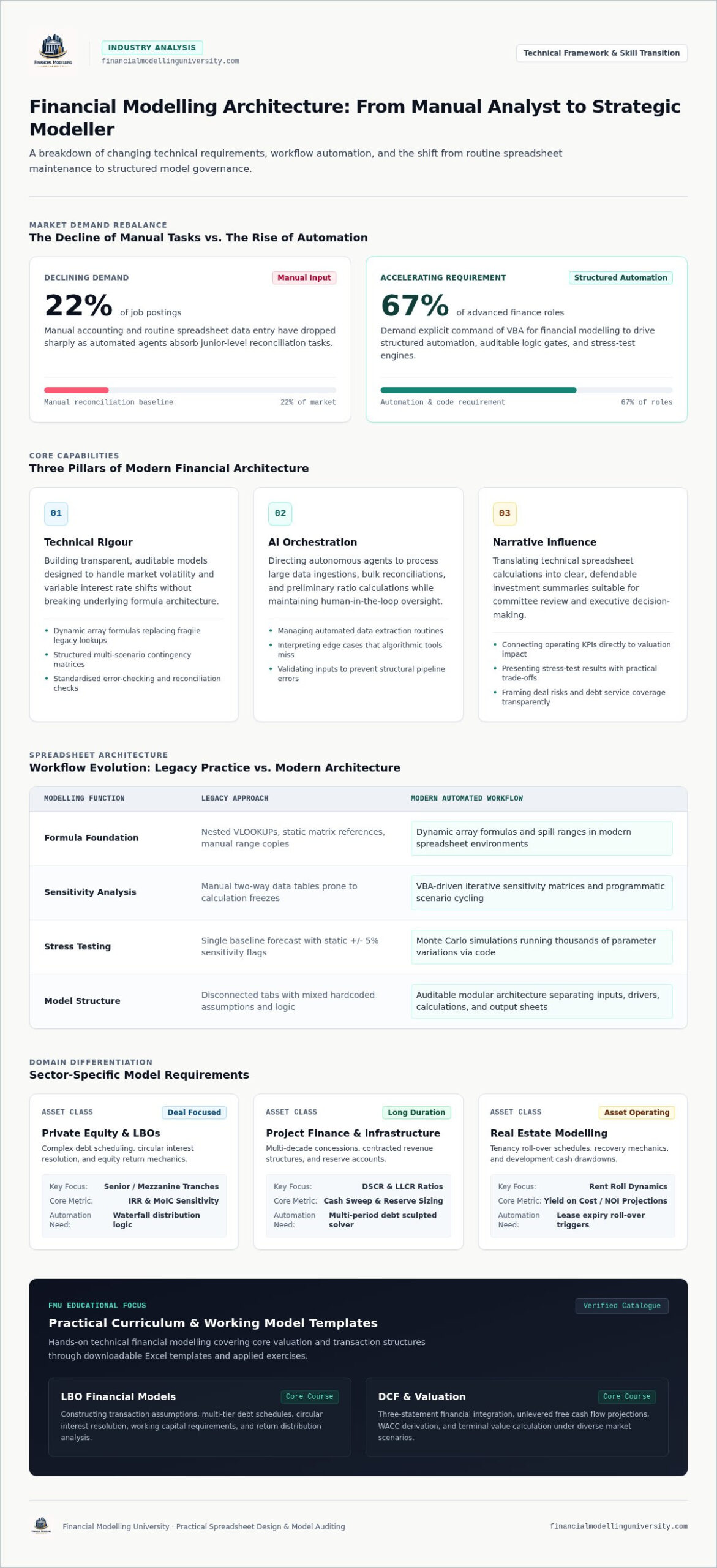
The 2026 market doesn’t reward generalists. As automation absorbs standard analytical tasks, the highest compensation tiers are reserved for those with niche expertise in high-barrier sectors. Project Finance and Infrastructure modeling are seeing a massive resurgence, driven by the global transition to a green-energy economy. These deals involve complex, long-term financing structures that require more than just basic Excel. You must build models that can handle non-recourse debt, tax equity flips, and tiered debt service coverage ratios with absolute precision.
Real estate modeling for multi-family, industrial, and retail assets has evolved significantly. In 2026, you’re expected to manage institutional-grade waterfalls that distribute cash flows across complex partnership structures. There is a sharp distinction between Development models, which focus on construction timelines and absorption rates, and Core+ acquisition models focused on stable yield. Mastering these differences is non-negotiable for anyone following our real estate financial modeling guide. High-stakes REFM requires a level of technical precision that basic spreadsheets cannot offer.
The Private Equity landscape in 2026 demands absolute mastery over complex debt waterfalls and internal rate of return (IRR) sensitivities. You aren’t just calculating a single number; you’re modeling for multiple exit strategies, including IPOs and secondary sale scenarios, under various macro-economic pressures. Mastering vba for financial modeling is critical here, particularly when building automated sensitivity tables that test the robustness of an LBO under fluctuating interest rates. For a comprehensive deep-dive into these structures, see our guide on private equity financial modeling.
To secure your position among the industry elite, you need the tools and templates used by the pros. Access our full suite of institutional-grade training through the FMU All-Access Pass and start your transition into a specialized expert today.
Success in the high-stakes financial landscape of 2026 requires more than a collection of fragmented skills. It demands a structured roadmap that synthesizes technical mastery with the strategic intuition required for elite deal-making. The FMU All-Access Pass provides this comprehensive ecosystem, offering a disciplined path for continuous upskilling. You aren’t just learning tools; you’re building a professional portfolio of institutional-grade models that prove your value before you even enter the room. By mastering vba for financial modeling within this framework, you demonstrate the ability to build the automation engines that drive modern investment banking and private equity.
The FMU Certification serves as a global signal of technical excellence. It confirms to senior partners and recruiters that you possess the technical rigor and strategic mindset required for Director-level responsibilities. This credential, backed by our proven curriculum, separates you from generalists who rely on basic spreadsheet logic. You’ll gain lifetime access to institutional-grade templates, ensuring your work always meets the standards of Tier-1 banks. This is about more than education; it’s about a total career transformation that positions you as a strategic architect in a competitive market.
Passive learning is insufficient for those aiming for elite roles. Moving beyond standard video lessons, our 1-on-1 career mentoring provides real-world deal feedback that mirrors the intensity of a live transaction. This mentorship is the fastest route to accessing the hidden job market of 2026, where the best roles are often filled through trusted industry networks. We prepare you for the technical “grill” of investment banking interviews, ensuring your command of vba for financial modeling and complex deal structuring is beyond reproach. You’ll learn to defend your assumptions with the confidence of an industry insider, turning technical questions into opportunities to showcase your strategic influence.
Your transition from Analyst to Senior Associate or VP requires a deliberate, step-by-step plan. You must bridge the gap between processing data and architecting deals. Leveraging our financial modeling course online provides immediate ROI by equipping you with the specialized technical stack demanded by elite firms. This plan focuses on technical rigor, AI orchestration, and narrative influence, ensuring your professional shelf life remains long in an automated world.
Don’t let your career growth stagnate while the industry evolves. Join over 25,000 finance professionals who have trusted FMU to catalyze their professional advancement. Master the technical stack, command the narrative, and secure your place at the level of elite industry practitioners. The roadmap is clear; the path to mastery is structured. Choose the path of excellence and master financial modeling like the pros today.
The financial landscape of 2026 demands a definitive shift from manual data processing to strategic deal architecture. You’ve seen how technical rigor and sector-specific specialization are the only ways to insulate your career from automation. Mastery of vba for financial modeling is no longer optional; it’s the bridge between being a user of tools and an architect of institutional-grade solutions. By synthesizing technical precision with high-stakes storytelling, you position yourself as an indispensable asset in any M&A or Private Equity firm.
Your path to the Director level is structured and proven. Trusted by over 25,000 finance professionals, FMU provides the blueprint for elite performance through institutional-grade Excel templates and direct 1-on-1 career mentoring. Don’t let your growth stagnate while the industry accelerates. Take command of your professional trajectory and perform at the level of the industry’s top practitioners.
Master Financial Modeling Like the Pros – Enroll in FMU University Today
The future of finance belongs to those who build it. Step into your role as a strategic leader and start your transformation today.
The most in-demand skills in 2026 center on strategic synthesis and technical orchestration. You must move beyond basic Excel into advanced vba for financial modeling to automate institutional-grade workflows. Mastery in niche sectors like Green Energy Infrastructure and Private Credit is also essential. Employers prioritize professionals who can translate complex algorithmic data into persuasive investment narratives for the committee.
Financial modeling remains the foundational source of truth for all high-stakes transactions. While AI agents excel at data cleaning and preliminary forecasting, they lack the strategic intuition required for complex deal architecture. You’ll use models to audit AI outputs and manage high-impact edge cases. In 2026, the model is the framework where human judgment meets machine efficiency.
The FMU Certification is the gold standard for practitioners aiming for Tier-1 bank roles. Unlike generic academic credentials, this certification focuses on the technical rigor required to build audit-ready, institutional-grade models. It signals to recruiters that you can handle the intensity of live M&A and Private Equity deals from day one with absolute precision.
Transitioning into Private Equity requires a shift from historical reporting to forward-looking deal structuring. You must master the LBO framework and understand the nuances of complex debt waterfalls. Building a professional portfolio of models through FMU proves you can handle the technical grill of PE interviews and deliver immediate value to the investment team.
The most effective way to learn LBO and M&A modeling is through direct application using institutional-grade templates. You should avoid theoretical textbooks that don’t reflect current market complexities. Focus on building models that account for high-interest environments and multiple exit scenarios, as these are the primary challenges facing professionals in the current landscape.
FMU differs from traditional universities by prioritizing practical, real-world application over academic theory. We provide direct 1-on-1 mentoring from industry experts who have already achieved success in elite firms. Our curriculum is designed for immediate career ROI, focusing on the specific technical stacks and institutional templates used by the world’s most prestigious financial institutions.
Learning agility is your capacity to unlearn obsolete manual habits and rapidly adopt new technical frameworks. In 2026, this means moving from static spreadsheet work to dynamic automation with vba for financial modeling. Professionals with high learning agility stay ahead of the automation curve by constantly refining their ability to synthesize AI-driven insights into strategic deal structures.
Dedicate five to ten hours per week to focused upskilling to maintain a competitive edge. Consistency is more important than intensity when mastering complex technical stacks. Prioritize high-impact skills that offer immediate productivity gains, such as automating repetitive sensitivity analyses, to ensure your time investment translates directly into professional advancement and mastery.