


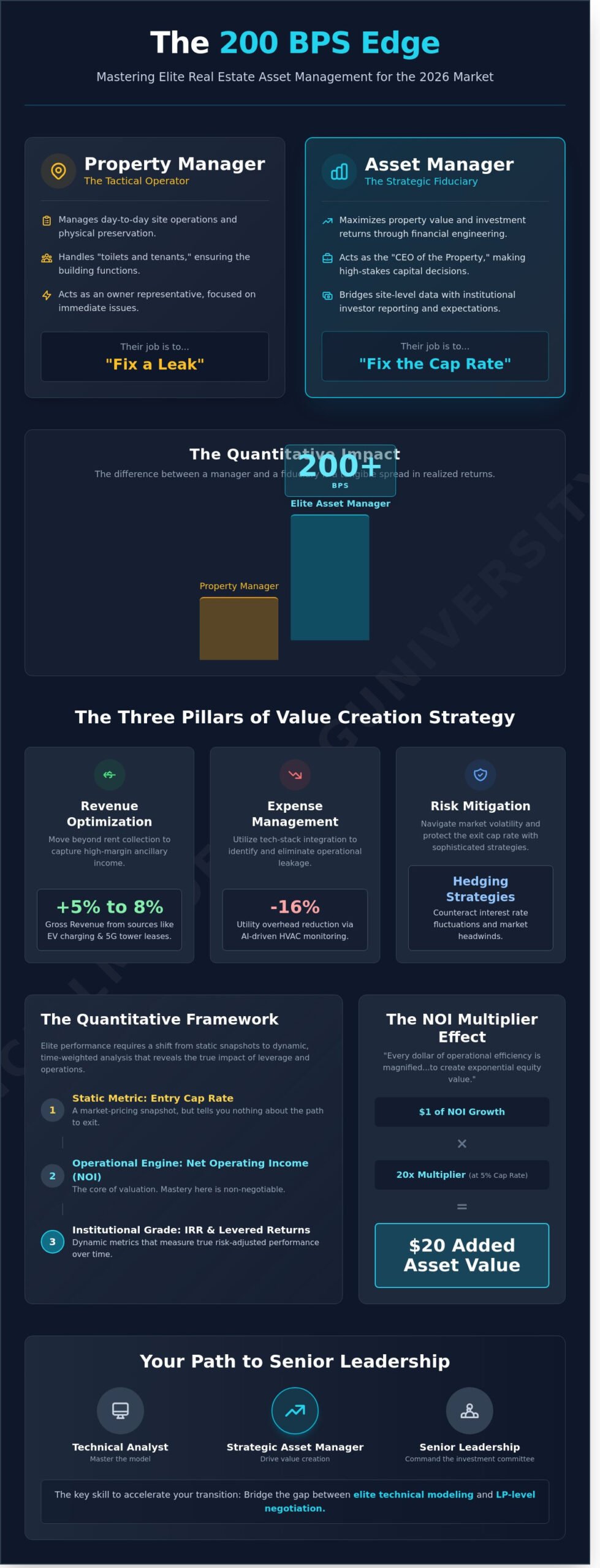
The difference between a property manager and an elite asset manager is a 200 basis point spread in realized returns that most firms simply leave on the table. You likely recognize that managing a physical site is fundamentally different from optimizing a complex financial vehicle. However, many professionals still fail to translate a tenant’s specific lease terms into a precise impact on the exit cap rate or the overall fund IRR. To dominate the market in 2026, you can’t just oversee operations; you must master real estate asset management as a technical discipline that bridges the gap between physical property performance and the rigorous outputs of an institutional financial model.
It’s time to stop guessing and start executing with the confidence of a private equity veteran. We’ll provide you with the exact technical roadmap used by the top 5% of global investment firms to maximize portfolio alpha and drive value-add execution. You’ll master the institutional metrics that separate senior leadership from mid-level analysts, giving you the specific tools required to command a seat at the investment committee table. From granular sensitivity analysis to strategic capital expenditure deployment, this guide is your definitive foundation for long-term financial leadership and professional superiority.
Real estate asset management is the strategic optimization of property value and investment returns through rigorous financial engineering. It’s the process of maximizing a property’s Net Operating Income (NOI) and terminal value while balancing the risk profile of the capital stack. In 2026, the distinction between a mere owner representative and a true fiduciary is the difference between surviving a market cycle and dominating it. An owner representative focuses on the physical preservation of the asset; a fiduciary focuses on the preservation and growth of the investor’s equity.
The asset manager operates as the CEO of the property. You aren’t a service provider. You’re the primary decision-maker responsible for the asset’s lifecycle. This role dictates when to deploy capital for major renovations and when to trigger a disposition based on yield compression trends. Asset management is a technical discipline of value creation that requires the precise calibration of operational data against capital market expectations, moving far beyond simple administrative oversight.
Success in real estate asset management rests on three execution-focused pillars. First, revenue optimization requires moving beyond basic rent collection. Modern institutional managers now capture ancillary income from EV charging infrastructure and 5G cell tower leases, which currently account for 5% to 8% of gross revenue in high-performing assets. Second, expense management utilizes tech-stack integration to identify operational leakages. Implementing AI-driven HVAC monitoring has reduced utility overhead by 16% across major metropolitan portfolios this year. Third, risk mitigation involves navigating the 2026 landscape of interest rate volatility. This requires sophisticated hedging strategies and a deep understanding of market-specific headwinds that could devalue the exit cap rate.
The difference between these roles is the difference between tactics and strategy. Property managers (PM) are tactical. They handle the “toilets and tenants,” ensuring the building functions on a daily basis. Asset managers (AM) are strategic. While a PM fixes a leak, the AM fixes the cap rate. The AM acts as the essential bridge between site-level operations and the LP/GP investors. They translate raw building data into the high-stakes reporting that drives distribution decisions. To bridge this gap effectively, you must master real estate financial modeling to ensure your projections align with institutional-grade standards.
Static metrics like the Entry Cap Rate provide a snapshot, but they fail to capture the velocity of capital. Elite real estate asset management requires a transition from static snapshots to dynamic, time-weighted analysis. While a 5% cap rate might signal market pricing, it tells you nothing about the risk-adjusted path to exit. You must master the metric hierarchy, moving from Net Operating Income (NOI) through debt service to arrive at Levered Cash-on-Cash returns. This sequence reveals the true impact of leverage and operational precision on investor distributions.
NOI is the engine of institutional valuation. The formula is straightforward: (Gross Potential Rent – Vacancy/Loss) + Miscellaneous Income – Operating Expenses. However, the mastery lies in the multiplier effect. At a 5% market cap rate, every $1 of NOI growth adds $20 of asset value. “In institutional real estate, every dollar of operational efficiency is magnified by the market cap rate to create exponential equity value.” Practitioners often stumble by misclassifying recurring CapEx as OpEx; this error artificially deflates NOI and suppresses the terminal valuation in a DCF model. Precision here is non-negotiable.
Precision in real estate asset management demands rigorous stress-testing. You shouldn’t just model a “base case.” You need to run sensitivity analyses that shock exit cap rates by 50 to 100 basis points or simulate a 10% vacancy spike. Effective managers then benchmark these results against the NCREIF Property Index or local Class A peer sets to ensure the Asset Management Plan (AMP) outperforms the market average. To build these models with institutional-grade accuracy, you should explore our advanced real estate modeling tracks which bridge the gap between theory and private equity execution.
Modeling a unit renovation program requires precision. You must weigh the incremental rent against the cost of capital. For instance, a $20,000 upgrade that adds $300 to monthly rent creates an 18% annual return on that specific outlay. Smart managers also hunt for “Green Alpha.” Integrating energy-efficient HVAC systems or LED lighting can reduce utility expenses by 10%, directly boosting NOI. For a deeper dive into these structures, consult our commercial real estate development guide.
Liquidity is tied to your Weighted Average Lease Expiry (WALE). Institutional buyers pay a premium for assets with a WALE exceeding 5.0 years because it represents de-risked cash flow. Your real estate asset management strategy must balance occupancy with credit quality. Negotiate Tenant Improvements (TI) and Leasing Commissions (LC) aggressively; these costs shouldn’t exceed 7% of the total lease value over the term, or you risk eroding the very equity you’re trying to build.
The most dangerous fallacy in the industry is the belief that real estate asset management becomes a passive endeavor once a property hits stabilized occupancy. This mindset leads directly to equity erosion. In 2026, market volatility dictates that every investment thesis requires constant re-underwriting. An Asset Management Plan (AMP) isn’t a static PDF tucked away in a closing binder; it’s a living financial model that reflects real-time shifts in interest rates and operating expenses.
Elite practitioners treat the AMP as a dynamic roadmap. If your exit cap rate assumptions haven’t moved despite a 50 basis point shift in the 10-year Treasury, your waterfall projections are essentially fiction. You’ve got to stress test your sensitivity tables monthly to ensure the GP catch-up remains achievable. Precision in these updates separates institutional-grade managers from amateurs who wait for the quarterly report to realize they’re underwater. You aren’t just reporting history; you’re forecasting the next tactical move to protect the internal rate of return.
Deciding when to exit requires calculating the Marginal IRR. This metric determines if holding the asset for one additional year generates a higher return than liquidating today and redeploying capital into a fresh 18% IRR opportunity. You must also identify “Capital Fatigue,” which occurs when projected CapEx requirements exceed 15% of the property’s gross asset value without a clear path to rent premiums. Adopting a project finance & infrastructure modeling mindset is vital here. It forces you to view real estate as a long-term cash flow engine where lifecycle costs dictate the terminal value.
Technical defaults often happen long before a payment is missed. You must monitor your Debt Service Coverage Ratio (DSCR) with surgical precision. If your DSCR trends toward the 1.15x or 1.20x threshold, you need a proactive strategy. This might involve strategic refinancing to pull equity at a 60% LTV or choosing to deleverage if debt service eats too far into the LP’s preferred return. Open communication with lenders during market stress isn’t a sign of weakness; it’s a tactical move to preserve the sponsor’s reputation and the deal’s viability.
Senior leadership in real estate asset management requires an absolute command of the underlying data. Technical modeling skills are the primary differentiator for those moving into Director or VP roles. At this level, you aren’t just reviewing spreadsheets; you’re defending every basis point of the IRR to sophisticated Limited Partners (LPs). If you can’t manipulate a waterfall on the fly during a board meeting, you lack the leverage required for elite decision-making.
The transition to seniority also demands a shift in soft skills. You’ll spend roughly 45% of your time negotiating with Property Managers to trim OpEx and the remaining 55% managing investor expectations. Mastery of the model gives you the authority to win these high-stakes conversations. When you can demonstrate exactly how a 50-basis-point shift in vacancy affects the GP promote, your strategic recommendations become unassailable.
To operate at an institutional level, your toolkit must include a robust three-statement model tailored for real estate entities. This ensures the P&L, balance sheet, and cash flow remain synchronized during complex refinancings or dispositions. You must also master waterfall distributions, specifically modeling the GP promote across tiered performance hurdles such as 8%, 12%, and 18% IRR benchmarks. Building institutional-grade reporting templates in Excel is the final step. These templates should automate 90% of data ingestion, allowing you to focus on high-level variance analysis rather than manual entry.
The real estate financial modeling course at FMU provides the technical architecture needed to dominate the real estate asset management sector. Our curriculum features a dedicated “Mastering Real Estate Waterfall Distribution” module. Here, you build complex, multi-tier promote structures from a blank sheet, ensuring you understand the logic behind the code.
Thriving in the 2026 market requires a shift from passive oversight to aggressive, data-driven performance. You’ve now seen how a rigorous quantitative framework and a 20% alpha-focused value-add strategy separate elite performers from the pack. Success in real estate asset management isn’t about simple property maintenance; it’s about the precision of your DCF modeling and the clarity of your institutional reporting. Senior roles in private equity demand you eliminate technical gaps and command the room with certainty. Precision is the only currency that matters in this league.
The gap between a mid-level analyst and a senior director is bridged through specialized technical mastery. You don’t have to navigate this transition alone. Our curriculum provides 15+ institutional-grade Excel templates and a globally recognized certification to validate your expertise. You’ll also receive one-to-one career mentoring from PE veterans with over 25 years of combined deal-room experience. It’s time to stop guessing and start executing at the highest level of the capital stack.
Master Institutional-Grade REFM with Financial Modelling University and secure your seat at the table. Your path to elite professional status starts with the next model you build.
A mid-level Real Estate Asset Manager in 2026 earns a base salary ranging from $145,000 to $185,000 according to updated industry projections from the CEL Compensation Survey. Total compensation packages for high performers at institutional firms often exceed $220,000 when you include performance bonuses and carried interest participation. Mastering complex waterfall modeling is the primary lever for reaching the upper decile of this pay scale.
Real estate asset management focuses on the operational execution and value maximization of specific properties, while investment management handles broader portfolio strategy and capital raising. Asset managers execute the business plan at the property level by managing CAPEX budgets and leasing velocity. Investment managers oversee the fund’s risk profile and investor relations, typically supervising 10 to 15 different assets simultaneously.
The Chartered Financial Analyst (CFA) and the CCIM (Certified Commercial Investment Member) designation are the gold standards for professionals seeking elite status. While the CFA proves rigorous analytical capacity, the CCIM provides practical, property-level expertise essential for real estate asset management roles. Most Tier 1 private equity firms prioritize candidates who also hold a specialized financial modeling certification to ensure technical precision in Excel.
You calculate the Internal Rate of Return by identifying the discount rate that makes the Net Present Value (NPV) of all cash flows from a project equal to zero. In a standard institutional model, you use the =XIRR() function in Excel to account for specific dates of capital calls and distributions. This metric is the primary benchmark for performance, reflecting the annualized effective compounded return rate over a 5 to 7 year hold period.
The most frequent error in real estate asset management reporting is failing to reconcile actual property performance against the original pro forma assumptions. Over 35% of institutional reports contain inaccuracies in calculating the debt service coverage ratio (DSCR) or misclassifying capital expenditures as operating expenses. These technical lapses undermine investor confidence and can lead to a 15% variance in projected versus realized distributions.
You can transition without a finance degree by demonstrating technical mastery of institutional-grade financial models and Argus Enterprise. While 65% of asset managers hold finance degrees, property managers who bridge the gap through specialized technical training succeed by leveraging their hands-on operational knowledge. You must prove you can translate physical building performance into a 10 year discounted cash flow analysis to be considered for these roles.
By 2026, AI has automated 40% of routine data entry and variance reporting tasks across the industry. Predictive analytics tools now forecast tenant churn with 92% accuracy, allowing managers to proactively negotiate renewals long before lease expiration. This shift requires professionals to move beyond basic data manipulation and focus on high-level strategic decision-making and complex deal structuring that algorithms can’t replicate.
A Value-Add strategy involves acquiring underperforming B-class assets and implementing a targeted capital improvement plan to increase Net Operating Income (NOI). This strategy typically targets a 12% to 18% IRR by renovating units, improving management efficiencies, or rebranding the property. Successful execution relies on your ability to model the precise timing of CAPEX outflows and the subsequent rental premiums achieved through these strategic enhancements.