


Investing in companies begins with understanding the financial instruments that represent ownership. Equity securities play a central role in capital markets, corporate finance, and portfolio management, making them essential for investors and finance professionals alike.
This guide explores how they work, their main types, and where they fit within an investment strategy.
Equity securities are financial instruments that represent an ownership interest in a company. Businesses issue them to raise capital for purposes such as expanding operations, funding acquisitions, investing in innovation, or supporting long-term growth.
When we purchase an equity security, we become shareholders with a proportional claim on the company’s assets and future earnings.
Investors generally earn returns from equity securities in two ways. Capital appreciation occurs when the market value of a security increases over time, while dividend income comes from profits that some companies distribute to shareholders.
The potential for these returns depends on factors such as financial performance, growth prospects, and overall market conditions.
Ownership also gives shareholders economic rights that extend beyond potential returns. Depending on the type of equity security, these rights may include voting on key corporate matters, receiving dividend payments, and sharing in the company’s remaining assets if it is liquidated.
The extent of these rights varies by security type, which we examine in the following section.

Equity securities can be grouped into several categories based on the rights and financial preferences they provide to shareholders. The most common types are common shares, preferred shares, and convertible preferred shares.
Common shares are the most common form of equity security and are typically listed on public stock exchanges.
They generally provide shareholders with:
Common shareholders have the lowest priority in the capital structure and receive any remaining assets only after creditors and preferred shareholders have been paid if the company is liquidated.
Preferred shares generally offer greater income stability than common shares.
They commonly include:
Most preferred shares do not carry voting rights, although the specific rights depend on the terms established when the shares are issued.
Convertible preferred shares give investors the right to exchange their preferred shares for a predetermined number of common shares under specified conditions.
This feature allows investors to receive the dividend preference associated with preferred shares while retaining the option to participate in future share price appreciation if the company’s value increases.
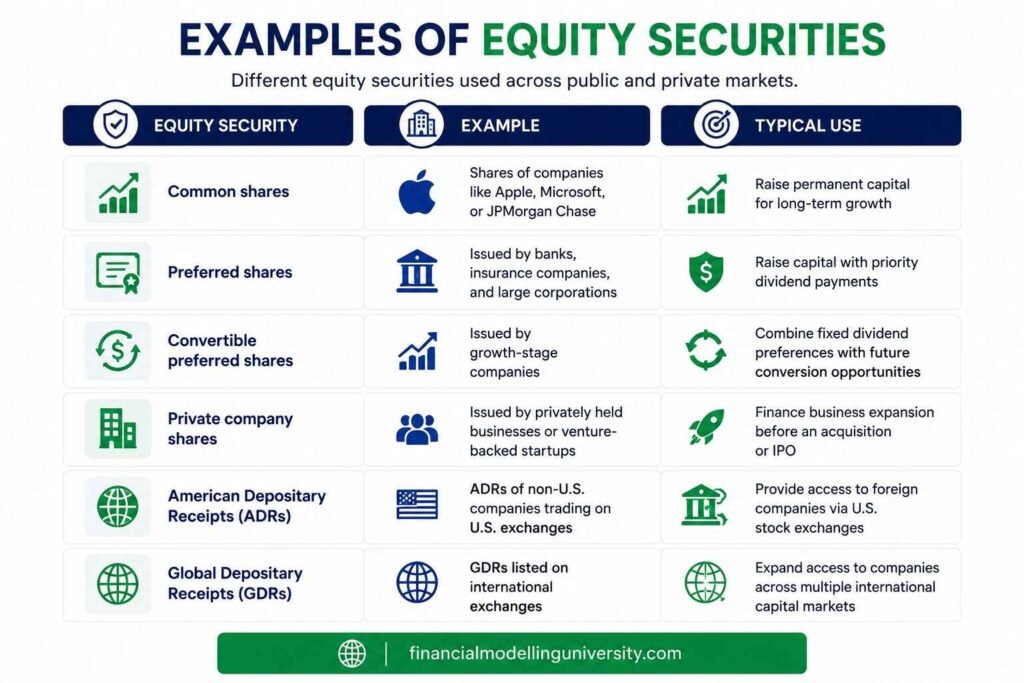
The following examples illustrate how different equity securities are used across public and private markets.
| Equity Security | Example | Typical Use |
| Common shares | Publicly traded shares of companies such as Apple, Microsoft, or JPMorgan Chase | Raise permanent capital while allowing investors to participate in the company’s long-term growth. |
| Preferred shares | Preferred stock issued by banks, insurance companies, and large corporations | Raise capital from investors seeking priority dividend payments. |
| Convertible preferred shares | Preferred shares issued by growth-stage companies | Attract investors by combining fixed dividend preferences with future conversion opportunities. |
| Private company shares | Equity issued by privately held businesses or venture-backed startups | Finance business expansion before an acquisition or initial public offering (IPO). |
| American Depositary Receipts (ADRs) | ADRs representing non-U.S. companies trading on U.S. exchanges | Give investors access to foreign companies through domestic stock exchanges. |
| Global Depositary Receipts (GDRs) | GDRs listed on international exchanges | Expand access to companies across multiple international capital markets. |
These examples demonstrate that equity securities are available in several forms, each serving different financing and investment objectives depending on the company’s stage of growth, capital requirements, and target investors.
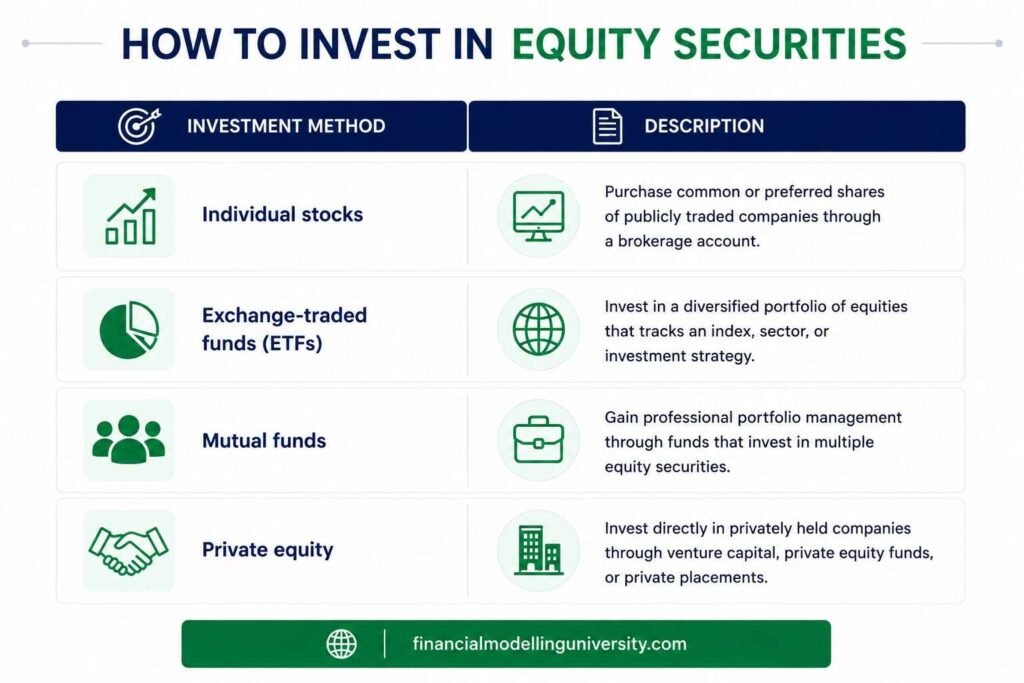
Investors can gain exposure to equity securities through several investment vehicles, depending on their financial objectives, risk tolerance, and investment strategy.
| Investment Method | Description |
| Individual stocks | Purchase common or preferred shares of publicly traded companies through a brokerage account. |
| Exchange-traded funds (ETFs) | Invest in a diversified portfolio of equities that tracks an index, sector, or investment strategy. |
| Mutual funds | Gain professional portfolio management through funds that invest in multiple equity securities. |
| Private equity | Invest directly in privately held companies through venture capital, private equity funds, or private placements. |
Public equity securities are bought and sold on regulated stock exchanges through brokerage accounts.
Private equity investments are acquired directly through venture capital, private equity funds, or private placements and typically involve longer investment horizons.
Regardless of the investment method, evaluating a company’s financial performance, competitive position, and valuation remains an essential part of the investment process.
Investors commonly use techniques such as financial statement analysis and comparable company analysis to assess whether an equity security is fairly valued. To learn more, explore our guides to Comparable Company Analysis (Trading Comps) and How to Work in Private Equity.
Like any investment, equity securities offer opportunities and involve trade-offs. Understanding both helps investors evaluate whether they align with their financial objectives and risk tolerance.
Equity securities can provide several long-term advantages, including:
Investors should also consider the risks associated with equity securities:
Managing these risks requires thorough research, diversification, and a long-term investment approach. Investors who regularly evaluate company fundamentals are generally better positioned to make informed investment decisions.
For a deeper look at how finance professionals assess publicly traded companies, see our guide to Equity Research Report Tutorial: Master Institutional-Grade Analysis (2026).

The value of an equity security depends on a company’s ability to generate sustainable earnings and create long-term value for shareholders. Investors assess this potential by analyzing profitability, growth prospects, and the return generated on shareholder capital.
One of the most widely used profitability metrics is Return on Equity (ROE). It measures how efficiently a company uses shareholders’ equity to generate net income.
A consistently high ROE may indicate effective management and efficient capital allocation, although it should always be evaluated alongside the company’s financial structure and industry peers.
Another important concept is the cost of equity, which represents the minimum rate of return investors expect for providing capital to a company. Businesses must generate returns that exceed their cost of equity to create shareholder value over the long term.
Investors also distinguish between a company’s book value and market value.
| Metric | Meaning |
| Book value | The accounting value of shareholders’ equity reported on the balance sheet. |
| Market value | The value investors assign to the company based on its current share price and future expectations. |
A company’s market value often differs from its book value because investors consider factors such as future earnings potential, competitive position, and expected growth.
Financial analysts frequently compare these measures when valuing businesses and assessing investment opportunities.
Our guide to DuPont Analysis: Mastering the Diagnostic Framework for Elite Financial Modeling explains how profitability drivers, including ROE, can be analyzed in greater detail.
Understanding equity securities is essential for evaluating businesses, building diversified portfolios, and making informed investment decisions.
By recognizing how different equity securities function and the factors that influence their value, we can assess opportunities more effectively and make investment decisions that align with our financial objectives.