


What does a 50% cash sweep repay? Not 50% of EBITDA. The percentage applies to eligible cash remaining after operating needs, interest, required amortisation and any other specified cash uses. Building an LBO debt schedule cash sweep in Excel means getting that cash flow waterfall right, especially when repayments reduce average debt and affect interest expense in the same period.
The clearest way to build the schedule is to define cash available for repayment, calculate mandatory amortisation, then apply the optional sweep in the right order across debt tranches. Interest based on average debt can make the calculation circular because the sweep affects the debt balance that determines interest. This article walks through the formulas, repayment caps and interest link. A hypothetical worked example traces cash through the schedule and checks that repayments, retained cash and closing debt reconcile.
A cash sweep directs a specified share of eligible excess cash to optional debt repayment. It does not calculate the debt balance by itself. The sweep rule determines how much cash to use; the debt schedule applies that repayment, subject to the amount outstanding and the repayment priority. Keeping those steps separate makes an lbo debt schedule cash sweep easier to trace and test.
In a leveraged buyout, operating cash flow supports debt service and repayment after the acquisition. Mandatory amortisation is scheduled principal repayment required by the debt assumptions. Optional repayment is additional paydown generated by the cash sweep. Calculate mandatory amortisation first, then apply the sweep to eligible cash. Neither repayment should exceed the debt balance available to repay.
Define the cash flow line used for the sweep and state what it includes. A common approach is to start with cash generated from operations, then deduct cash interest, cash taxes, capital expenditure and increases in working capital. Include other required cash uses or a minimum cash balance when the model assumptions call for them.
Working capital movements can materially change the cash pool. An increase, such as more cash tied up in receivables or inventory, reduces cash available for repayment. A release can increase it. Align the cash flow definition with the operating assumptions and debt terms. Otherwise, the model could direct cash to repayment that the business needs for another use, or exclude cash that the terms make available.
Show the sequence explicitly. First calculate required amortisation, capped at the opening debt balance. Then calculate the cash eligible for the optional sweep. If the assumptions require some cash to remain in the business, exclude that amount before applying the sweep percentage.
Optional sweep repayment = MIN(eligible cash × sweep percentage, debt after mandatory amortisation)
This cap prevents optional repayment from exceeding either eligible cash or the debt remaining after required amortisation. The sweep percentage alone does not determine paydown: cash generation, mandatory repayments and repayment priority all affect the result.
Keep cash flow, principal repayments and debt balances on separate lines. That makes it easier to see whether a formula uses cash before or after mandatory amortisation. Use the same currency and time period throughout, such as £m for each financial year.
Start with cash available before principal repayment, after the cash items defined in the model. Calculate actual mandatory amortisation, then deduct it to find residual cash. Apply the sweep percentage and cap optional repayment at both eligible residual cash and the debt remaining after mandatory amortisation:
For example, with 25 units of available cash, 4 units of mandatory amortisation and a 75% sweep, residual cash is 21 units and the optional repayment is 15.75 units, assuming sufficient debt remains. If cash available is below mandatory amortisation, show the shortfall rather than treating the cash sweep as a funding source. The model should make clear how that deficit is funded or carried forward.
With multiple tranches, allocate repayments according to the debt waterfall. If one tranche ranks first, direct eligible cash to it until it is repaid or the cash pool is exhausted. Then apply any remaining amount to the next tranche. Don’t assume pro-rata repayment unless the debt terms specify it. Roll forward each tranche separately and reconcile the individual ending balances to total debt.
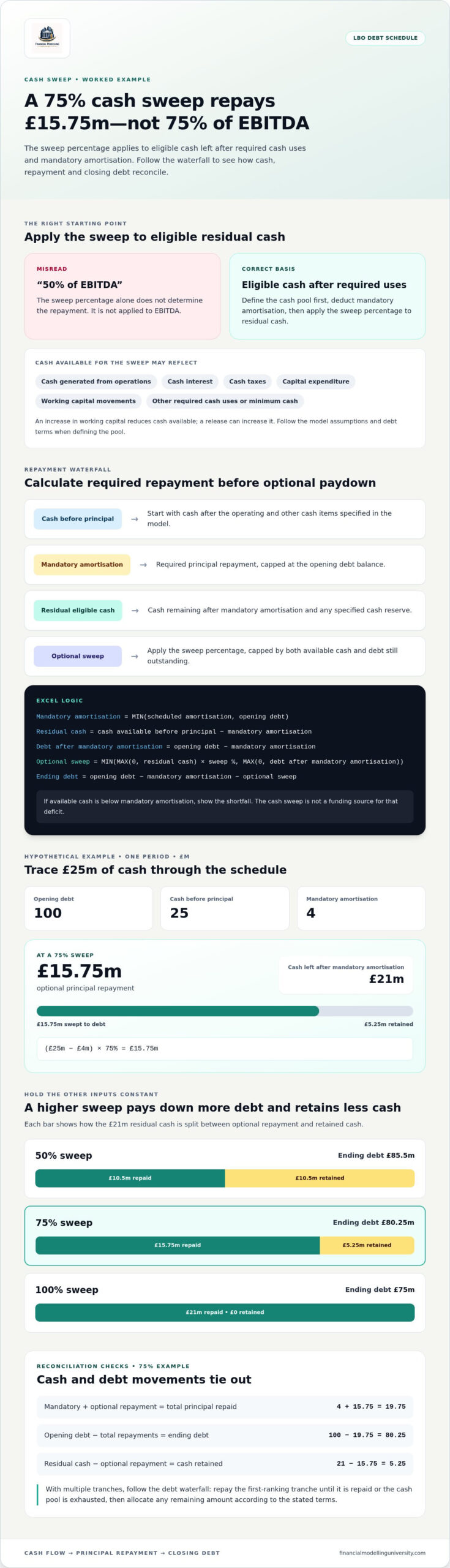
Use these hypothetical assumptions, with all figures in £m for one period: opening debt of 100, cash available before principal repayment of 25, mandatory amortisation of 4, and a 75% sweep. Assume there are no other cash uses or debt tranches.
| Calculation | Formula | Result (£m) |
|---|---|---|
| Residual cash after mandatory amortisation | 25 − 4 | 21 |
| Optional sweep repayment | 21 × 75% | 15.75 |
| Total principal repaid | 4 + 15.75 | 19.75 |
| Ending debt | 100 − 19.75 | 80.25 |
| Cash retained | 21 − 15.75 | 5.25 |
Check the schedule in both directions. Mandatory amortisation plus optional repayment equals total principal repaid: 4 + 15.75 = 19.75. Opening debt less total repayments equals ending debt: 100 − 19.75 = 80.25. Residual cash less the optional repayment equals cash retained: 21 − 15.75 = 5.25. These checks confirm that cash and debt movements reconcile under the stated assumptions.
Hold the other inputs constant. At a 50% sweep, optional repayment is 10.5, ending debt is 85.5 and retained cash is 10.5. At a 100% sweep, optional repayment is 21, ending debt is 75 and retained cash is zero. A higher sweep reduces debt faster but leaves less cash available to the business. It does not automatically maximise equity returns, because liquidity needs, future investment and the effect of lower debt on interest can also influence the outcome.
A sweep percentage does not determine debt paydown on its own. Eligible cash flow and repayment priority matter too. Audit the full lbo debt schedule cash sweep, not just the percentage input. Repayments should be capped at eligible cash and debt outstanding, and mandatory amortisation should not be deducted twice when calculating cash for the optional sweep.
Interest can create a circular reference when the model calculates it on average debt. Average debt depends on the ending balance after repayment, but repayment depends on cash available after interest. Each calculation therefore feeds back into the other. If this link is unintended, formulas may fail to converge or produce misleading outputs.
One approach is to enable controlled iteration in Excel and check that the results stabilise. Another is to use a documented non-circular assumption, such as calculating interest on opening debt. That simplifies the calculation, but does not reflect the effect of within-period repayments on interest. State the method clearly and apply it consistently.
Separate the schedule into assumptions, cash flow, repayment calculations and balance checks. Use consistent units and signs. For example, show debt repayments as positive amounts in their own rows, then subtract them in the debt roll-forward. Check that opening debt less total principal repaid equals ending debt, and that no tranche falls below zero.
Label the cash flow line that feeds the sweep and keep the formulas readable. Add a separate check for any shortfall between cash available and mandatory amortisation, and make sure the cash retained after optional repayment follows the model’s minimum cash assumption. These checks help a reviewer trace the calculation from operating cash flow to closing debt.
A reliable cash sweep starts with a clearly defined cash flow available for repayment, then applies mandatory amortisation and the optional sweep in the correct order. The lbo debt schedule cash sweep should cap repayments at eligible cash and debt outstanding, while keeping each tranche’s balance easy to reconcile.
Before relying on the output, test how changes in cash generation, the sweep percentage and repayment priority affect closing debt. Check the interest calculation too: using average debt can link repayment back to interest and create circularity. Document whether the model uses iteration or a non-circular assumption so another reviewer can follow the logic.
Practise these steps with Financial Modelling University’s LBO financial modelling course, which includes step-by-step video lessons and practical exercises, as well as downloadable Excel models and templates.
A cash sweep uses a specified share of eligible cash flow for optional debt repayment. Define the cash pool after relevant cash uses and mandatory amortisation, then apply the sweep percentage subject to debt outstanding and repayment priority. Any eligible cash not used for optional repayment remains in the business. Document the assumptions so the calculation can be followed and tested.
Start with the model’s defined cash flow before principal repayment. Include the specified cash items, such as cash interest, taxes, capital expenditure and working capital movements. Deduct mandatory amortisation to find residual cash available for the optional sweep. Keep each step on a separate, clearly labelled line, then reconcile the cash calculation to the model’s cash balance. This shows reviewers which uses reduce repayment capacity.
No. Mandatory amortisation is scheduled principal repayment based on the debt assumptions. A cash sweep is an optional repayment calculated from eligible residual cash and a specified sweep percentage. Show them separately and apply them in the required order. In the debt roll-forward, subtract both from opening debt: ending debt equals opening debt less mandatory amortisation and optional repayment. This avoids counting required repayment twice.
Circularity can arise when interest expense is based on average debt, because the cash sweep changes the ending debt balance. Interest then affects cash available for repayment, which affects the sweep and debt balance again. Handle this transparently: use controlled Excel iteration and check that results stabilise, or adopt a documented non-circular interest assumption. The latter simplifies the calculation but may not capture the effect of repayments on same-period interest.
Confirm that the formula uses the intended cash flow after mandatory amortisation, follows the stated repayment priority and cannot exceed eligible cash or debt outstanding. Then reconcile opening debt less mandatory and optional repayments to ending debt. Also check that residual cash equals the amount swept plus cash retained under the model’s assumptions. These tests make the lbo debt schedule cash sweep easier to audit and help isolate formula errors.