

What if you spent 3,000 hours earning a credential only to realize you still cannot build a deal-ready merger model from scratch? This is the reality for many professionals caught in the debate of financial modeling certification vs cfa as they plan their 2026 career trajectory. While the CFA charter remains a prestigious signal of intellectual discipline, the recent 39% pass rate for Level I highlights a grueling path that often misses the technical, day-one Excel skills required by elite firms like Goldman Sachs.
You recognize that prestige matters, but you also know that practical execution is what actually gets you hired. This masterclass provides a definitive ROI comparison between the multi-year CFA journey and specialized modeling certifications. We will break down the costs, curriculum updates, and a decision framework tailored to your goals in Investment Banking or Asset Management. It is time to stop guessing and start building a path to mastery that 25,000+ finance professionals have already used to transform their careers.
The finance industry has reached a tipping point. In 2026, the traditional prestige of a pedigree is no longer enough to secure a seat at a top-tier firm. Recruiters now demand “Day One Deal Ready” talent. This shift creates a critical tension in the financial modeling certification vs cfa debate. While one offers a vast intellectual ocean, the other provides the high-performance engine needed to navigate it. Professionals who rely solely on theoretical knowledge find themselves facing a “Credibility Gap” when tasked with building a complex transaction model under pressure.
The Chartered Financial Analyst (CFA) program remains the undisputed gold standard for investment management. It builds a rigorous foundation in ethics, financial reporting, and global asset valuation. However, having the brain for finance does not mean you have the hands to execute a deal. Specialized certifications have emerged as the specialist’s path to technical mastery, focusing on the “Strategic Architect” mindset. At FMU, we’ve seen 25,000+ finance professionals pivot toward this practical approach to ensure they can perform at the level of elite industry practitioners from their first hour on the job.
The CFA curriculum is a marathon of discipline. It spans three levels, requiring a baseline commitment of 300 to 400 hours per exam level. Level I focuses on foundational tools, Level II on asset valuation, and Level III on portfolio management and ethics. It is the primary credential for those targeting roles in Asset Management, Hedge Funds, and Equity Research. While the CFA Institute has introduced small practical modules, the core focus remains on broad academic rigor rather than the granular, “no-mouse” Excel speed required in the trenches of a deal team.
Specialized certifications focus on the technical engine of the deal. This path prioritizes mastering an institutional-grade LBO or a multi-scenario M&A model. The “Hands-On” advantage is clear: you learn by building complex models from scratch rather than just studying them. These programs are the preferred choice for roles in Investment Banking, Private Equity, and Corporate Development. They bridge the gap between academic theory and real-world application, allowing you to master financial modeling like the pros using institutional-grade templates and protocols.
Choosing between these paths depends on your 2026 career goals. If you want to manage a $10 billion pension fund, the CFA is your North Star. If you want to lead a $500 million LBO transaction, technical modeling mastery is your most valuable asset. The elite 1% of analysts increasingly recognize that these are not mutually exclusive; they are complementary tools for career transformation.
The CFA charter is the heavy artillery of the investment world. It signals a level of intellectual endurance and ethical commitment that top-tier banks still prize in 2026. If you want to master the language of global capital markets, the CFA provides the essential vocabulary. It remains a powerful signal to recruiters at firms like Goldman Sachs and J.P. Morgan, proving you have the mental stamina to survive a multi-year gauntlet. This prestige is anchored in a rigorous ethical framework, which serves as an invaluable asset in the highly regulated 2026 market environment.
According to FINRA’s overview of the CFA, the program is a rigorous indicator of professional excellence in portfolio management and investment analysis. To address the evolving demand for technical skills, the CFA Institute has integrated Practical Skills Modules (PSM). While these modules acknowledge the necessity of modeling, they typically offer only 10 to 20 hours of instruction. This is a far cry from the deep-tissue technical training required for elite transaction roles, creating a significant distinction in the financial modeling certification vs cfa comparison.
Despite its prestige, the CFA often leaves analysts stranded when they enter a live deal environment. Candidates frequently struggle with excel for finance because the exam focuses on multiple-choice theory rather than blank-sheet execution. There is also a distinct lack of sector-specific depth. You won’t find the granular mechanics of real estate financial modeling or complex project finance within the core CFA curriculum. The CFA exam represents a “Theoretical Ceiling” where academic brilliance meets the limits of spreadsheet execution. If you need to bridge this gap quickly, consider how FMU can turn that theoretical knowledge into deal-ready technical mastery.
If the CFA charter is the brain of the investment world, a specialized financial modeling certification is the hand that executes. In the 2026 financial modeling certification vs cfa landscape, the winner for transaction-heavy roles is determined by “Deal Velocity.” Top-tier firms no longer have the patience for slow, academic approaches to spreadsheet construction. They value analysts who can build a DCF valuation in hours, not days, while maintaining institutional-grade accuracy. This requires a “Strategic Architect” mindset, where you move beyond simple data entry to structure the logical flow of a multi-million dollar transaction.
The immediate ROI of this path is undeniable. While the CFA offers a theoretical promise, modeling mastery provides downloadable Excel templates that you can apply to live client presentations tomorrow. Modern industry standards demand proficiency in LBO, M&A, and Project Finance modeling from day one. At FMU, we ensure our 25,000+ professionals don’t just learn the theory but master the actual mechanics of the deal. You aren’t just studying a textbook; you’re building the technical engine that drives career transformation.
Specialization is the key to outperforming your peers in a crowded market. Deep-diving into investment banking financial modeling allows you to master the specific nuances of transaction structures that the CFA barely touches. Mentorship plays a critical role here. Instead of deciphering static textbooks, you receive 1-to-1 guidance from industry pros who have lived through the high-stakes environment of Wall Street. You walk into interviews not just with a credential, but with a portfolio of completed models that prove your technical readiness.
The time commitment is perhaps the most stark differentiator. A specialized certification typically takes 3 to 6 months to complete, compared to the grueling 3-year minimum for the CFA journey. This follows a “Just-in-Time” learning model, where you upskill specifically for the role or deal you are targeting right now. For junior associates, the ability to audit a complex LBO model in minutes rather than hours translates to immediate visibility and respect within elite deal teams. This efficiency allows you to accelerate your career trajectory without sacrificing years of your life to a generalist curriculum.
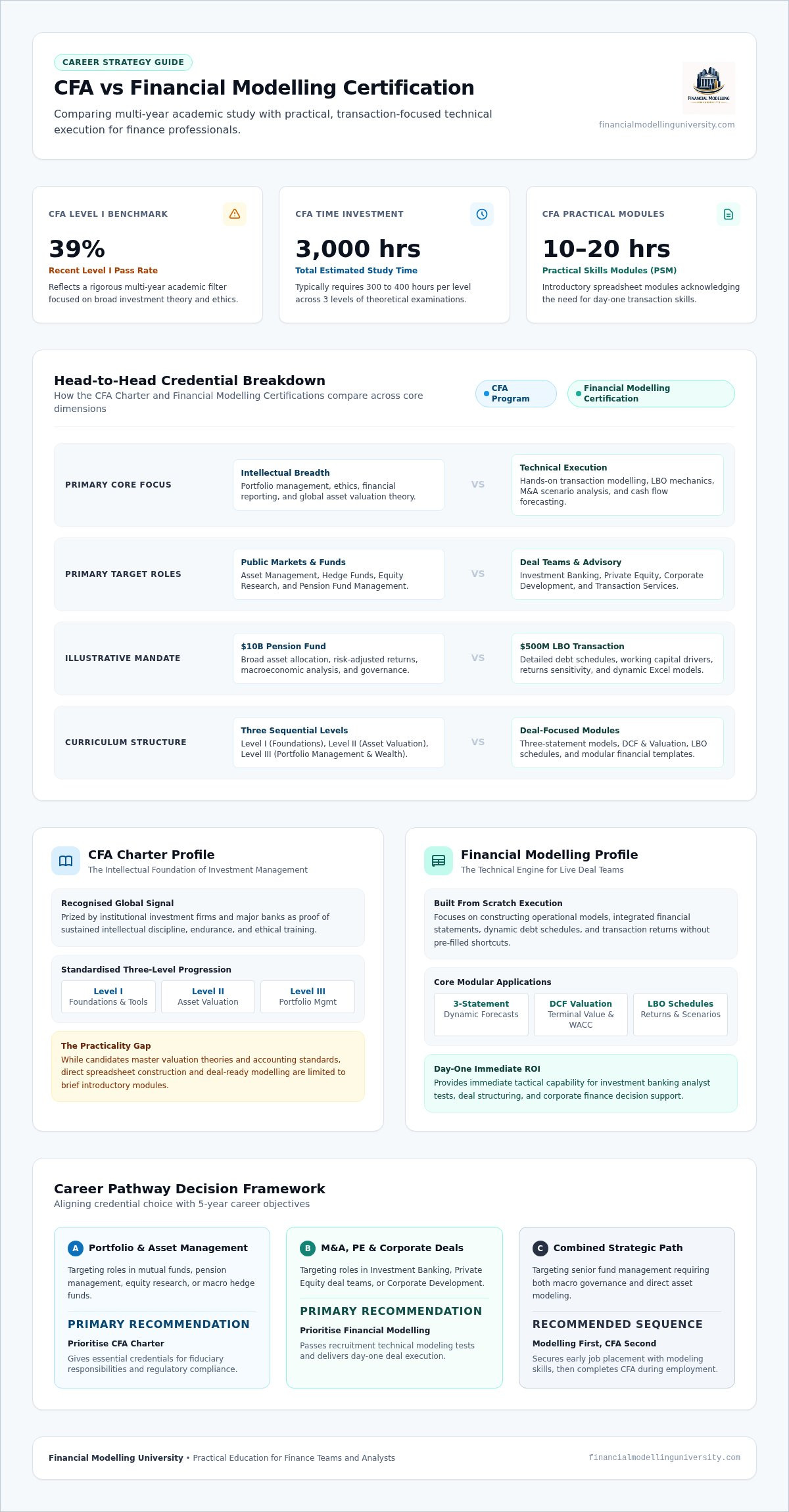
Deciding on a financial modeling certification vs cfa is not a binary choice. It is a strategic allocation of your most valuable asset: time. In the high-pressure environment of 2026, firms like J.P. Morgan and Goldman Sachs have shifted their hiring filters. They no longer just look for the CFA’s intellectual signal; they prioritize candidates who can immediately audit a complex LBO or build a multi-scenario M&A model. The opportunity cost of the CFA is high, requiring a 3,000-hour commitment that can span years. If your immediate goal is to break into a deal-focused role, you must weigh that multi-year marathon against the 3-to-6 month sprint of a technical masterclass.
The elite 1% of analysts utilize a “Hybrid Mastery” strategy. They treat the CFA as a long-term signal of professional ethics and endurance while using FMU as their practical lab. This approach ensures you don’t just pass exams but actually master the technical execution that drives transaction value. By combining the two, you eliminate the “Practicality Gap” and position yourself as a rare asset who possesses both academic rigor and elite-level Excel speed.
When quantifying the return on investment, you must distinguish between short-term entry and long-term prestige. A modeling certification gets you the job now by proving you can handle the technical workload of a junior associate. Data indicates that professionals with these technical certifications report earning 15% to 25% more than their uncertified peers, a “Technical Premium” that pays off well before a CFA charter is granted. The CFA remains a powerful long-term moat for your career, but it won’t help you build a deal-ready merger model by next Monday. For those ready to accelerate their trajectory, the FMU All-Access Pass provides the institutional-grade tools to secure that technical edge immediately.
The choice between a financial modeling certification vs cfa often comes down to the difference between knowing the theory and executing the deal. Financial Modelling University (FMU) bridges this gap by providing a “University” experience that moves far beyond basic online tutorials. We don’t just teach you how to use Excel; we train you to operate at the level of elite industry practitioners. Our curriculum is built on institutional-grade Excel protocols, ensuring that every model you build meets the rigorous standards of a high-stakes deal team.
Prestige is earned through results. FMU is trusted by 25,000+ finance professionals who have used our training to secure roles at top-tier firms and accelerate their career transformation. When you join FMU, you gain access to a globally recognized network and the same institutional-grade templates used by professionals at the world’s leading investment banks. This isn’t just educational content. It is the practical lab where CFA candidates and working professionals refine the technical skills that a generalist curriculum simply cannot provide.
The FMU All-Access Pass provides the ultimate technical toolkit for the modern analyst. You gain unlimited entry to our entire library of specialized training, allowing you to pivot between sectors with confidence. Whether you need to master an Investment Banking Financial Modeling Course or dive into a Project Finance & Infrastructure Modeling Course, the resources are at your fingertips. Our platform includes:
Master Financial Modeling Like the Pros with FMU
Most Managing Directors (MDs) view technical errors as a primary risk. You can position an FMU certification as a critical risk-mitigation tool that ensures your work is accurate, fast, and follows firm-wide best practices. We provide a “Training Request Template” designed to help you articulate the immediate ROI of our courses, making it easy to get your enrollment fully funded by your employer. FMU is the preferred corporate training partner because our curriculum is built on the exact Excel protocols used by the world’s leading investment banks and private equity funds. Don’t let your technical skills hit a theoretical ceiling. Take command of your professional development and build the technical engine that will drive your career in 2026 and beyond.
Navigating the financial modeling certification vs cfa decision requires a clear-eyed assessment of your immediate career velocity. You’ve seen that while the CFA charter signals long-term intellectual endurance, it often leaves a “Practicality Gap” in the high-stakes environment of live deal execution. Elite analysts in 2026 recognize that technical mastery is the fastest path to credibility at firms like Goldman Sachs. By prioritizing “Day One” skills, you position yourself as a rare asset who can translate complex theory into professional-grade models.
FMU provides the practical lab you need to bridge this gap. Trusted by 25,000+ finance professionals, our platform offers the technical engine for your career transformation. You gain access to 1-to-1 career mentoring from industry experts and the exact institutional-grade Excel templates used by elite practitioners. Don’t let your ambition be limited by a theoretical ceiling. Take command of your professional development and execute with the precision of a master.
Enroll in the FMU All-Access Pass and Master Modeling Today
Yes, for immediate technical execution, a modeling certification is often superior. While the CFA signals intellectual discipline, it doesn’t provide the “no-mouse” Excel speed required in the trenches of a deal team. Banking recruiters prioritize candidates who can build a three-statement model or a merger analysis from scratch. Mastering these technical skills ensures you are deal-ready from your first hour on the desk.
You can secure a role in private equity with a modeling certification, particularly if you demonstrate mastery of complex LBO structures. Private equity firms are lean and need analysts who can audit transaction models without hand-holding. A certification proves your technical proficiency. However, pairing this with relevant transaction experience or a strong academic background is essential to compete for elite associate positions.
Financial modeling certifications are significantly more cost-effective than the multi-year CFA journey. The minimum total cost for the CFA program is approximately $3,520 if you pass all levels on the first attempt with early registration. In contrast, modeling certifications often offer lifetime access for a fraction of that investment. This creates a higher immediate ROI by delivering job-ready skills in months rather than years.
No, CFA Level 1 does not provide sufficient hands-on experience for a junior analyst role. The curriculum focuses on accounting principles and financial statement analysis rather than building dynamic, multi-scenario models in Excel. While the Practical Skills Modules (PSM) offer a brief introduction, they lack the depth required to handle institutional-grade transaction modeling in a high-pressure deal environment.
List your modeling certification under a dedicated “Certifications” or “Technical Skills” section to highlight your practical edge. If you are a CFA candidate, include your status, such as “CFA Level II Candidate,” in the same area. This strategic placement demonstrates a balanced profile of academic rigor and technical execution. It signals to recruiters that you possess both the intellectual brain and the hands-on skills for the job.
The CFA exams are objectively more difficult due to the sheer volume of material and low pass rates, with May 2026 Level I rates at 39%. However, a professional modeling certification presents a different challenge: technical precision and speed. While the CFA tests your ability to memorize and apply theory, modeling certifications test your ability to build error-free, institutional-grade tools under tight deadlines.
AI will not replace the need for financial modeling skills by 2026; it will augment them. While AI can automate basic data entry, elite analysts are still required to audit logic, structure complex deal nuances, and provide strategic interpretation. Mastery of financial modeling allows you to leverage AI tools more effectively. Firms continue to value professionals who understand the underlying mechanics of a valuation rather than those who rely on black-box automation.
You can study for both simultaneously, as they are highly complementary. Using a modeling certification as your “practical lab” helps reinforce the accounting and valuation concepts you learn in the CFA curriculum. This approach prevents burnout by breaking up theoretical study with hands-on Excel work. Balancing the financial modeling certification vs cfa prep ensures you are building a dual-threat profile that elite firms prioritize.