


What if your financial model is actually the greatest risk to your project’s bankability? In 2026, with the One Big Beautiful Bill Act (OB3) accelerating construction deadlines to July 4, lenders have zero patience for spreadsheets that break under stress. If your debt sizing logic collapses during scenario testing or your circular references baffle senior auditors, you aren’t performing at an institutional level. Mastering project finance model best practices is no longer a career advantage; it’s a baseline requirement for anyone operating in the current 3.75% Fed Funds environment.
You understand the frustration of a model that lacks transparency or fails to scale as deal complexity grows. We’ll show you how to transform your workflow into a rigorous, modular system that meets the highest analytical standards. You’ll learn to handle complex debt sculpting and waterfalls with the precision of an industry insider. This article provides the blueprint to build audit-ready infrastructure models from the ground up; we’ll ensure you’re prepared to lead high-stakes deals and command respect from the most demanding credit committees.
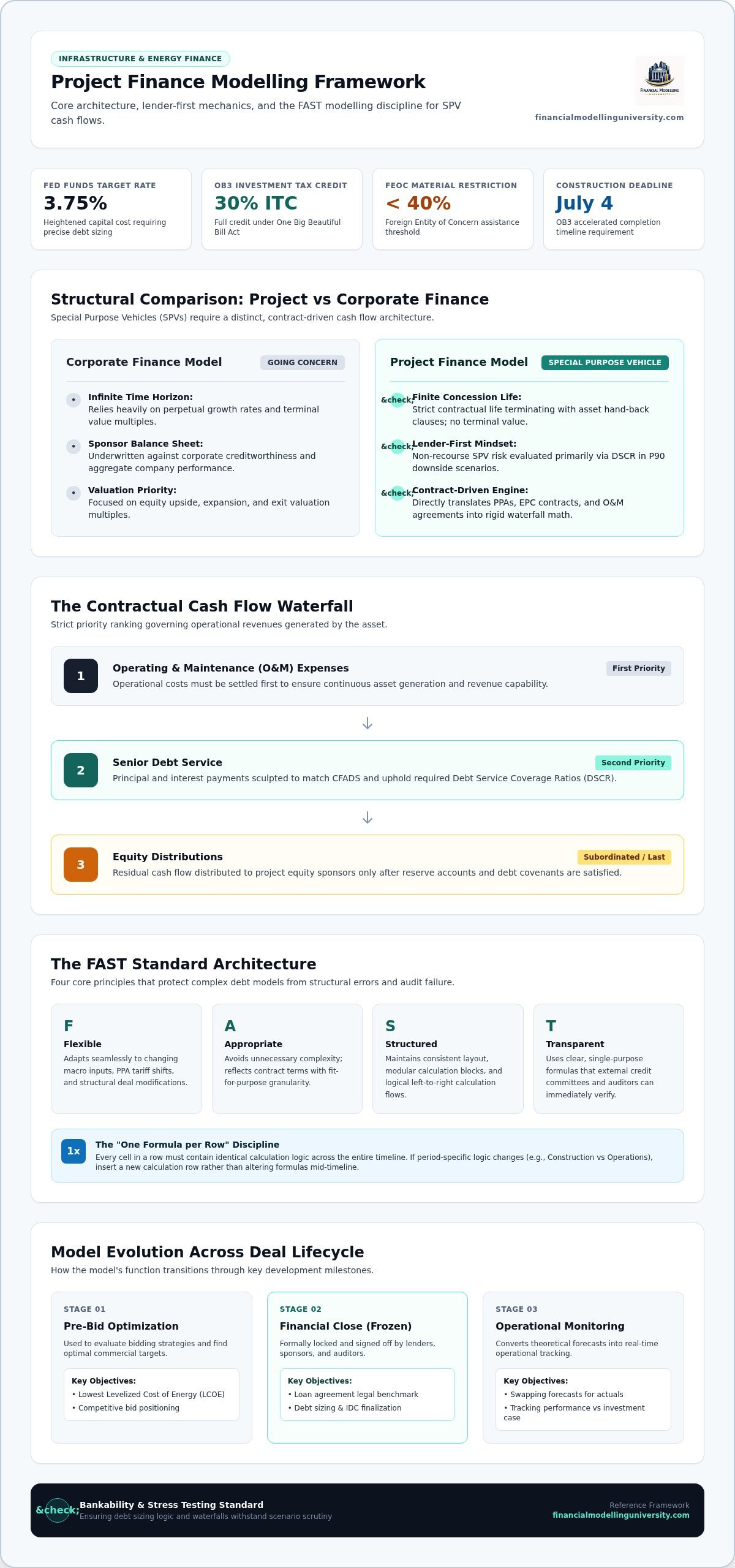
Building an institutional-grade project finance model requires a fundamental departure from traditional corporate valuation. In corporate finance, you’re modeling a going concern with an infinite horizon. In project finance, you’re modeling a Special Purpose Vehicle (SPV) with a hard expiration date. Every formula must reflect the “Lender-First” mindset. Banks don’t care about your aggressive growth targets; they care about the Debt Service Coverage Ratio (DSCR) in a P90 downside scenario. Adhering to project finance model best practices means treating the spreadsheet as a legal document that translates thousands of pages of contracts into a single, unbreakable cash flow waterfall.
The model acts as the single source of truth for all stakeholders. It bridges the gap between technical engineers, legal counsel, and the credit committee. If the Power Purchase Agreement (PPA) dictates a specific tariff escalation, that logic must be hard-coded and transparent. Any deviation between the model and the project documents is a red flag that can stall a deal for months. In the high-stakes environment of 2026, where the Fed Funds Target Rate sits at 3.75%, the cost of capital is too high to permit structural ambiguity.
This year also marks a definitive shift toward ESG-integrated infrastructure requirements. Under the One Big Beautiful Bill Act (OB3), securing the full 30% Investment Tax Credit (ITC) now requires rigorous modeling of Foreign Entity of Concern (FEOC) restrictions. If your model cannot prove that prohibited material assistance is below the 40% threshold, your tax equity assumptions are invalid. Elite modelers don’t just track cash; they track regulatory compliance as a primary driver of bankability.
Corporate models rely on terminal values and exit multiples. Project finance models are defined by a finite life. When the concession ends, the asset often reverts to the owner via a “Hand-back” clause. You aren’t modeling perpetual growth; you’re modeling the depletion of a contract. The cash flow waterfall is the heart of the engine. It dictates the strict hierarchy of payments: O&M expenses first, senior debt second, and equity distributions last. Because infrastructure projects often lack historical data, your technical assumptions drive the entire valuation.
Your model changes purpose as the deal progresses. During the pre-bid stage, it’s an optimization tool used to find the lowest levelized cost of energy or the highest competitive bid. At financial close, the model becomes “Frozen.” This version serves as the benchmark for the loan agreement. Once the project enters the operational stage, the model transitions into a monitoring tool. You’ll swap out aggressive assumptions for actual performance data to track the investment case against reality. Following project finance model best practices ensures this transition is seamless rather than a total rebuild.
Structure is the invisible backbone of bankability. An elite modeler doesn’t just build for functionality; they build for the person who has to audit the file six months later. Adhering to the FAST Standard is the global benchmark for this level of integrity. By prioritizing flexibility, appropriateness, structure, and transparency, you ensure your model survives the rigors of a credit committee review. This methodology isn’t a suggestion. It’s a professional requirement for institutional-grade infrastructure deals in 2026. If your model isn’t transparent, it isn’t institutional.
One of the most critical project finance model best practices is the “One Formula per Row” rule. Every cell in a row must contain the exact same logic across the timeline. If you need a different calculation for a specific period, you don’t change the formula in the middle of the sheet. You create a new row. This consistency is your ultimate defense against the “ghost errors” that plague amateur spreadsheets. It allows an auditor to verify a twenty-year timeline by checking a single cell. It’s about building a system that is impossible to break.
Modular architecture separates the “what” from the “when.” Your model should be partitioned into distinct blocks to maintain clarity. Start with a centralized Input Block. This is where every macro assumption, from the 4.48% 10-Year U.S. Treasury rate to specific technical specs, lives. Never bury an input inside a formula. The Calculation Engine follows, breaking complex logic into manageable, step-by-step rows. Finally, the Output Dashboard presents the results. Lenders and C-suite executives don’t want to see your working; they want to see the DSCR and equity IRR in a clean, professional format. Mastery of these structures is exactly what we teach in our Project Finance & Infrastructure Modeling Course.
Eliminate “Spaghetti Logic” by favoring vertical flow over horizontal complexity. Your calculations should read like a story, moving logically from top to bottom. Avoid the temptation to use complex nested IF statements. If a logic path requires more than two conditions, break it into separate flags. This “No Hidden Logic” rule ensures anyone can follow your thought process without a manual. By using advanced Excel for Finance techniques, you can build models that are as readable as they are powerful. Remember, a model that is hard to understand is a model that is hard to trust. In high-stakes infrastructure finance, trust is the only currency that matters. Following project finance model best practices ensures you never lose that trust during a critical audit.
Mastering the analytical engine of an SPV requires more than just Excel proficiency. It demands a deep understanding of how financial constraints dictate project capacity. Debt sizing is the pivot point where your model meets lender reality. Unlike corporate loans, project debt is sized against specific coverage ratios, primarily the Debt Service Coverage Ratio (DSCR) and the Loan Life Coverage Ratio (LLCR). Adhering to project finance model best practices means your sizing logic must be robust enough to handle the 4.48% 10-Year U.S. Treasury benchmark while maintaining a minimum DSCR of 1.20x or higher, depending on the asset class.
The complexity intensifies when you layer in the cash flow waterfall. This is the mechanical heart of the model, moving revenue down through operating costs, taxes, and debt service before reaching equity. A professional Introduction to Project Finance Modelling often highlights the hierarchy of these payments as the project’s most critical risk-mitigation feature. You must also account for reserve accounts, such as the Debt Service Reserve Account (DSRA) and Maintenance Reserve Account (MRA). These accounts act as liquidity buffers, and their funding and release mechanics must be modeled with absolute precision to avoid overstating available cash.
Circularity is the most common point of failure in infrastructure models. It typically arises from Interest During Construction (IDC) and fees, which are funded by debt, but the debt size itself depends on the total project cost including those very interests and fees. Resolving this loop without breaking the model’s integrity is a hallmark of an elite modeler. Following project finance model best practices ensures that your solution is transparent, documented, and capable of passing a third-party audit without raising red flags.
In 2026, the industry standard for handling circularity is the VBA “Copy-Paste” macro. While Excel’s native iterative calculation exists, it’s often rejected by auditors for being opaque and prone to instability. A robust VBA loop allows you to break the circularity by pasting values, ensuring the model remains stable during heavy scenario testing. You should always document the macro’s logic and provide a clear “Solve” button on the dashboard. This approach provides the transparency that lenders demand during the financial close process.
Debt sculpting is the art of matching repayment profiles to the project’s seasonal or cyclical cash flows. Instead of flat principal payments, you’ll calculate repayments that maintain a constant DSCR over the loan life. This maximizes debt capacity and improves equity returns. For sponsor-led deals, you may also need to integrate Private Equity Financial Modeling concepts, such as cash sweeps. When a project outperforms, excess cash is “swept” to accelerate debt repayment, a mechanic that protects lenders while impacting the timing of sponsor distributions.
Lenders don’t care about your “Base Case” or your “Upside.” They focus almost exclusively on the “Downside” or “Lender Case.” In a 2026 environment where the 10-Year U.S. Treasury sits at 4.48%, the cost of debt is a significant pressure point. Your model must demonstrate exactly how much stress the project can withstand before the Debt Service Coverage Ratio (DSCR) breaches its covenant. Following project finance model best practices means your spreadsheet isn’t just a calculation tool; it’s a risk-mitigation engine designed to answer the hardest questions a credit committee can throw at you.
Negotiations often happen in real time. If a lender asks, “What happens to the DSCR if construction costs overrun by 12%?” you cannot afford to say you’ll get back to them tomorrow. You must have a model robust enough to toggle that assumption and produce an audit-ready result instantly. This level of responsiveness builds the trust necessary to reach financial close. If your model breaks during a live sensitivity test, you aren’t just losing a deal; you’re damaging your professional reputation.
Professional models use the CHOOSE and INDEX functions to create a centralized scenario manager. This allows for seamless switching between Base, Upside, and Lender cases without altering underlying formulas. You must model macro risks like inflation and interest rate volatility with precision. In 2026, scenario-specific flags are essential for handling technical delays or cost overruns that might trigger Foreign Entity of Concern (FEOC) disallowed credits. To master these advanced structural techniques, enroll in our Project Finance & Infrastructure Modeling Course.
A non-balancing model is a career-ender. The “Balance Sheet Check” must be visible on every sheet to ensure total assets always equal total liabilities and equity. Use Excel’s Trace Precedents tool to map logic flow and eliminate “orphan” cells that reference nothing. An audit-ready model is one where any third party can trace a result back to its raw input in under 60 seconds. Before submitting any file for lender review, ensure it passes these five integrity tests:
Implementing these project finance model best practices ensures your work survives the scrutiny of elite auditors. It transforms your model from a simple spreadsheet into an institutional-grade financial instrument that commands respect from senior practitioners.
Technical modeling isn’t a back-office support function; it’s the primary gatekeeper for VP and Director roles in infrastructure finance. In the high-stakes environment of 2026, senior practitioners don’t just look for “Excel users.” They look for strategic architects who can defend a multi-billion dollar capital structure under intense lender scrutiny. If you can’t build a robust, audit-ready model from scratch, you’ll remain stuck in execution roles while others lead the deal. Mastering project finance model best practices is the definitive line between a functional analyst and an industry expert who commands the room.
The transition to elite status requires moving beyond basic spreadsheets. It’s about understanding how technical assumptions drive legal and financial outcomes. Our Financial Modeling Course Online bridges the gap between academic theory and institutional reality. We provide the blueprint for building models that don’t just calculate numbers but mitigate risk. In a market where Tier-1 investment banks and infrastructure funds demand immediate proficiency, having a portfolio of proven, institutional-grade models is your most valuable asset.
Stop relying on fragile templates that break when you change a single input. Our curriculum forces you to build institutional-grade models from a blank sheet. You’ll learn to handle the complexities of the One Big Beautiful Bill Act (OB3) and the nuances of the 3.75% Fed Funds environment. We also provide one-to-one mentoring to help you solve real-world deal complexities with experts who have already reached the top. For those working on mixed-use projects, we integrate Real Estate Financial Modeling principles to ensure you can handle cross-sector infrastructure assets with ease.
Credibility in 2026 is built on quantitative proof. Use FMU certificates to enhance your standing with global lenders and elite investment firms. Building a portfolio of audit-ready models is the fastest way to accelerate your career advancement. Don’t settle for being another analyst in the crowd. Join the 25,000+ finance professionals who have already mastered financial modeling with FMU and transformed their careers. Take control of your professional trajectory. Master the mechanics of project finance like the pros, and position yourself for the most prestigious roles in the industry. Adhering to project finance model best practices isn’t just about accuracy; it’s about the prestige and authority that comes with being an industry leader.
The path to financial close is paved with rigorous logic and structural integrity. By prioritizing the FAST standard and mastering the mechanics of debt sculpting, you move beyond simple spreadsheet management to become a strategic architect of infrastructure deals. Implementing these project finance model best practices ensures your analysis remains robust under the most extreme lender sensitivities. In a market where precision is the only metric that matters, your ability to deliver transparent, audit-ready results will define your professional trajectory.
Ready to elevate your career to the next level? Master Project Finance Modeling Like the Pros with FMU. Our curriculum is trusted by 25,000+ finance professionals and provides the institutional-grade Excel templates you need to build with confidence. Earn a globally recognized certification that validates your expertise and signals your readiness for the industry’s most high-stakes roles. The world’s most complex infrastructure projects require elite modelers who can bridge the gap between technical engineering and financial bankability. Start your transformation today and lead the deals of tomorrow.
The most common mistake is hard-coding assumptions within calculation formulas. This practice violates the FAST standard and makes a model impossible to audit or update efficiently. Professional modelers always separate inputs from calculations to ensure that a single change in an assumption sheet flows correctly through the entire model without manual intervention. Maintaining this discipline is a core component of project finance model best practices.
Circular references are typically handled using a VBA macro that runs a copy-paste loop. This macro calculates the interest during construction (IDC), copies the result, and pastes it as a value back into the model until the difference between iterations is negligible. While some modelers use algebraic solutions to avoid macros, the VBA approach is often preferred by lenders for its superior transparency and stability during scenario testing.
An acceptable Debt Service Coverage Ratio (DSCR) depends entirely on the project’s specific risk profile. For stable, regulated utility projects, a DSCR of 1.20x might be acceptable to lenders. However, higher-risk merchant power or mining projects often require ratios of 1.50x or even 2.00x. Your model must demonstrate that the DSCR remains above the covenant threshold even in a stressed Lender Case scenario.
The Debt Service Coverage Ratio (DSCR) measures a project’s ability to service debt in a specific period, usually a year or six months. In contrast, the Loan Life Coverage Ratio (LLCR) provides a more holistic view by looking at the present value of all future cash flows available for debt service over the remaining life of the loan. Both metrics are critical for debt sizing and monitoring covenants throughout the project lifecycle.
It’s possible to build a project finance model without VBA by using algebraic solutions or enabling iterative calculations in Excel. However, iterative calculations are notoriously unstable and often lead to model crashes during complex scenario testing. Most institutional-grade models utilize simple, transparent VBA macros to handle debt-sizing loops. This approach ensures the reliability and precision that elite finance firms expect from their lead modelers.