
An online financial modeling certification can suit analysts, finance professionals, business owners and learners who want to build or review Excel models. It is most useful when you need practical skills in forecasting, DCF valuation or LBO analysis, rather than a credential alone. Choose training that matches the models you expect to use.
A certificate shows that you completed structured learning, but employers may also want evidence that you can build a clear, reliable model and explain its assumptions. If you are comparing financial modeling training with CFA study, first identify the skills your target role requires.
Learn who these courses suit, which modeling skills they cover, how employers may view a certificate and what to consider when comparing costs. This guide also explains how to assess course content, practise in Excel and choose a learning path that fits your goals.
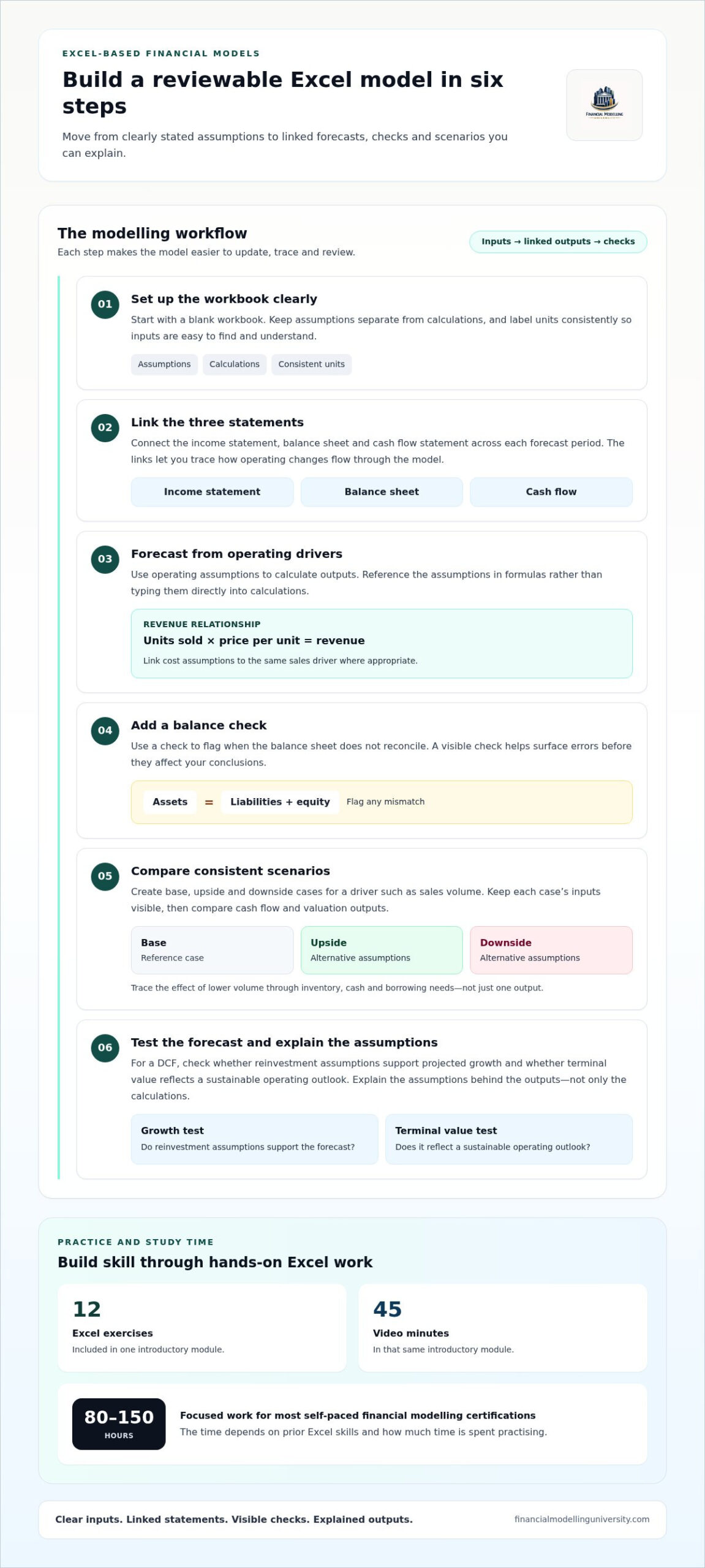
A useful online financial modeling certification should have you build models, not just watch lessons. Start with a blank workbook, separate assumptions from calculations, and label units consistently. In a three-statement model, link the income statement, balance sheet and cash flow statement so each forecast period reconciles. You can then trace how a change in revenue affects profit, working capital and cash.
Excel formulas turn operating assumptions into outputs. For example, forecast revenue as units sold multiplied by price per unit, then link cost assumptions to the same sales driver. Use cell references rather than typing assumptions into formulas. Add a balance check that flags when assets do not equal liabilities plus equity. These steps make banking models easier to review and update.
Scenario analysis shows how results respond when assumptions change. Create base, upside and downside cases for a driver such as sales volume, then compare cash flow and valuation outputs. Keep each case’s inputs visible and consistent. You can see how lower volume affects inventory, cash and borrowing needs, rather than manually changing a single output.
When comparing online financial modeling certifications, look for one that matches your target model and includes substantial Excel practice. Check whether the curriculum covers three-statement modeling, valuation or LBO schedules, and whether you will build a working model as part of the assessment. These criteria apply to learners worldwide.
Ask whether an Excel-based proctored examination is part of the assessment, and what it tests. A proctored exam means the candidate completes an assessment under supervision; the format and permitted tools can vary by programme. Choose Excel training that includes worked exercises and clear video lessons. One introductory module includes 12 Excel exercises and 45 video minutes. Most self-paced financial modeling certifications take 80-150 hours of focused work, depending on prior Excel skills and practice time.
A forecast is more useful when each assumption has an owner, source and update rule. In a corporate model, note whether a cost comes from a supplier contract, hiring plan or management estimate. Separate volume, price and mix so finance teams can identify what changed. This structure also makes forecast updates easier to review and explain.
FP&A teams can improve forecasting by keeping the budget, latest forecast and actual results distinct. Add a variance bridge that explains differences through operational drivers, timing or one-off items. For example, a delayed project launch may shift revenue into a later period without changing underlying annual demand. This helps teams prepare decisions instead of simply reporting variances.
Valuation depends on forecast quality as well as the method selected. In a DCF, test whether reinvestment assumptions support projected growth and whether terminal value reflects a sustainable operating outlook. An online financial modeling certification may cover these links, along with accounting, working capital and capital allocation. Look for exercises that ask you to explain assumptions, not just calculate outputs.
Keep scenarios internally consistent. A downside case might combine weaker customer retention with higher acquisition costs, while a separate sensitivity table isolates each driver. Compare the resulting cash generation and financing needs, then document which assumptions management can influence. This helps decision-makers avoid treating a single sensitivity as a complete business scenario.
To practise FP&A and forecasting, turn a forecast into a decision memo. State the key assumption, the operational evidence behind it and the action to take if results diverge. Courses differ in their coverage of valuation and planning, so compare their exercises with the models you expect to use professionally.
A modeling certificate can support a career move, but it does not replace evidence of applied skill. Match the course to the work you want to do: investment banking roles may require LBO analysis, while corporate finance teams often need operating forecasts and cash flow planning. FP&A roles use budgets, variance analysis and rolling forecasts. Choose a course that prepares you for tasks named in relevant job descriptions.
Employers may assess a credential alongside your work samples and ability to explain assumptions. Prepare a concise example, such as a three-statement model with clearly labelled inputs, linked schedules and balance checks. Be ready to explain how a revenue assumption affects working capital and cash. This shows whether you understand the model, not just its formulas.
Do online financial modeling certifications include continuing education credits or career support? FMU awards a certificate of completion for each course, which you can display on your CV or LinkedIn profile. Selected courses include live Q&A sessions and webinars, and one-to-one career mentoring is available. A completion certificate is not the same as continuing education credit.
Build a portfolio around the career path you are pursuing. For investment banking, document an LBO’s debt schedule, cash sweep and return drivers. For corporate finance, show a forecast connecting sales volumes, pricing and costs to cash needs. Use fictional or public information appropriately, label assumptions and include a short audit trail. Never present a practice model as client work.
In interviews, explain one modeling decision clearly. For example, describe why you linked inventory to sales instead of holding it flat, then show the effect on cash flow. This demonstrates accounting logic, forecasting judgment and communication. A certificate signals structured study; a clean model and clear explanation make your skills visible to hiring teams.
Compare course content before comparing costs. An Excel module and a course covering statement modeling, valuation and private equity analysis provide different kinds of practice. Check whether lessons, exercises and downloadable materials are included, and whether the course awards a certificate of completion. Then match the materials to the model you need to build, such as an LBO or cash flow forecast.
Subscription plans and fixed-course purchases can structure access differently. A subscription typically charges for access over a defined billing period; a fixed-course purchase charges for a specific course. Before choosing, read the access terms, renewal conditions, course expiry rules and certificate requirements. These details affect how you schedule learning and whether you can revisit a debt schedule or income forecast later.
Course cost is shaped by curriculum depth, assessment, learning materials and access duration. For example, a course with guided modelling exercises may suit someone who needs to practise a statement model, while a video-only course may provide less hands-on work. Compare the actual tasks, not just the title or the credential. A certificate records completion; it doesn’t by itself demonstrate that you can build or audit a model.
Use a simple comparison before enrolling. Note the course topics, practical exercises, access terms, assessment method and certificate conditions. Then identify the model you will produce, such as an income statement forecast linked to working capital and cash flow. If private equity is your target, prioritize LBO debt schedules and returns over unrelated topics. The right fit depends on the skills you need to practise.
Once you’ve compared the learning materials and terms, choose the format that fits your study habits and the modelling work you want to practise. Keep the comparison focused on useful course content, clear assessment expectations and a realistic plan for applying each skill.
Financial Modelling University offers an LBO Financial Models online course for learners focused on leveraged buyout analysis. It is designed for those who want to work through an LBO model and understand how its components connect, rather than study general finance concepts alone.
The course includes step-by-step video lessons, practical financial modeling exercises and downloadable Excel models and templates. As you work through an exercise, trace how the financing structure affects the model’s outputs. If your immediate focus is discounted cash flow analysis, FMU’s DCF & Valuation online course covers that subject.
Choose a course based on the analysis you want to practise. An LBO course focuses on buyout modeling; a DCF course focuses on valuation. Set your learning objective first, then use it to guide your practice.
Choose a model that reflects the work you want to do, then practise building it from assumptions to outputs. Treat an online financial modeling certification as a structured learning route, not a substitute for demonstrating your judgment. As you study, keep a clean version of each exercise and note why you chose its key assumptions. That record can help you explain your approach in an interview or when presenting analysis to colleagues.
Before enrolling, compare the course focus with the modelling task you want to tackle next. Financial Modelling University offers structured online learning for practical financial modelling. Explore the available financial modelling courses and select a path that fits your goals. Build deliberately, test your assumptions and keep improving the models you can confidently explain.
FMU’s courses suit students, finance professionals and investment enthusiasts seeking practical modeling skills. A business owner preparing a funding plan, for example, could benefit from learning how assumptions flow through projected statements. No prior finance experience is needed, though basic knowledge is helpful. Choose a course based on the model you want to build, such as an LBO for private equity analysis or a DCF valuation.
FMU supports multi-currency payments and automatically calculates VAT or sales tax based on the learner’s country. These are course prices, not a general market range.
FMU’s globally recognized certificate of completion for each course can be displayed on a CV or LinkedIn profile. The certificate documents course completion, while your ability to apply the material remains important in hiring discussions. For example, you could share a permitted practice model and explain its assumptions, checks and outputs. It is not an external academic accreditation.
No prior finance experience is needed for FMU courses, though basic knowledge is helpful. If you are new to modeling, start by getting comfortable with Excel formulas, cell references and basic accounting terms. Then practise tracing one assumption, such as sales volume, through revenue and cash flow. This preparation can make advanced topics easier to follow without delaying your start.
Do not assume every course requires a proctored examination or uses a shared passing score. FMU awards a certificate of completion for each course. Check the specific course details to understand its assessment and completion requirements, and distinguish a completion certificate from an exam-based professional designation before enrolling.
FMU offers a free Financial Modelling Starter Kit with five Excel templates: DCF Valuation Model, 3-Statement Financial Model, IRR Calculator, Cap Table Template and Sensitivity Analysis Tool. It also includes a 15-minute video walkthrough. The kit provides a way to practise core modelling tasks; it isn’t a course completion certificate. No discount is needed to access this free resource.